
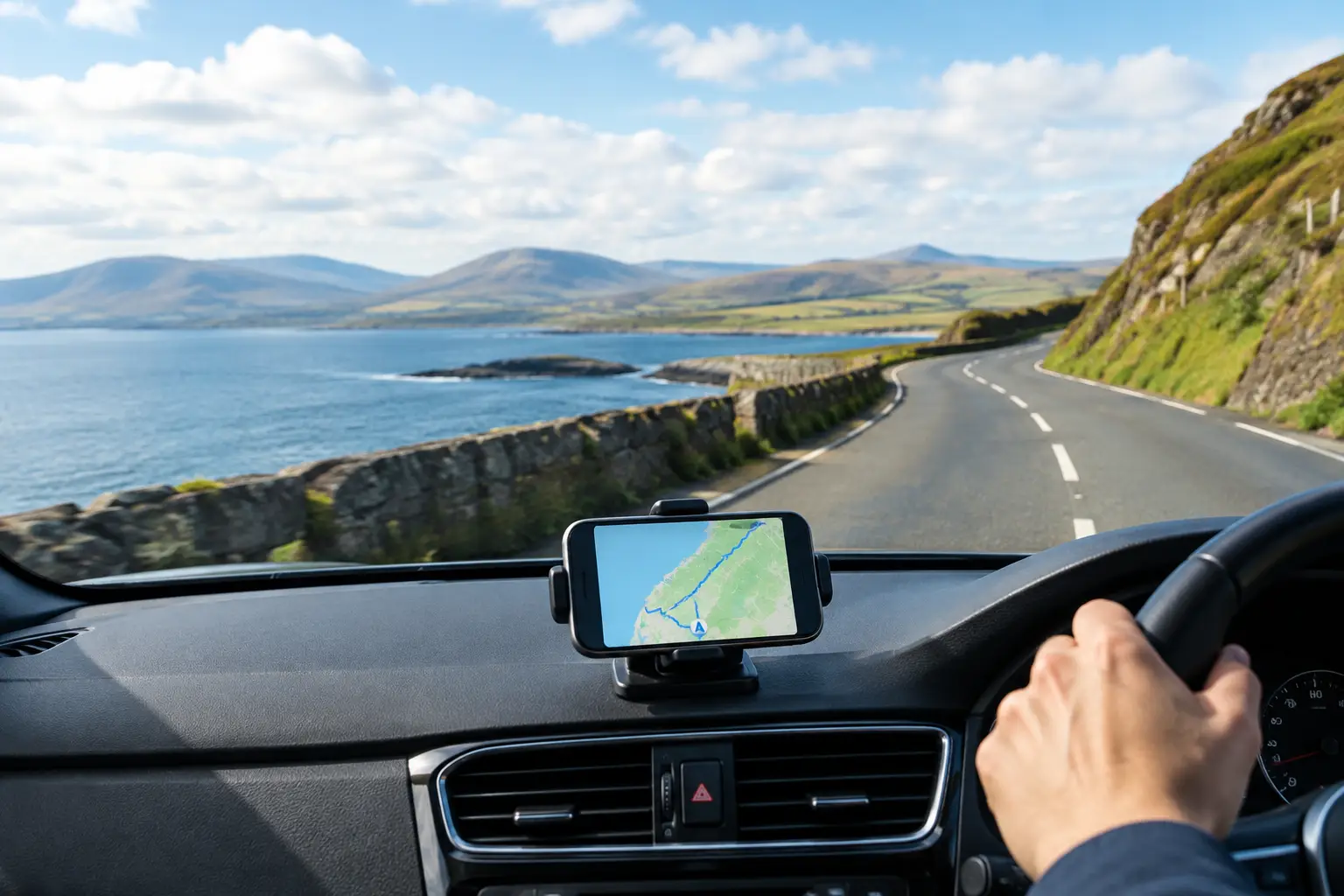
The Beara Peninsula is for travellers who would rather pull over for a changing view than race between famous landmarks. Its roads follow the edges of Cork and Kerry, linking colourful harbours, quiet beaches, old copper-mining country and high mountain passes. This Beara Peninsula driving guide will help you shape a realistic day behind the wheel, with enough time left for the places that make the route memorable.
Is the Beara Peninsula worth driving in one day?
Yes, provided you treat it as a scenic loop rather than a checklist. The peninsula is smaller and generally quieter than the neighbouring Ring of Kerry, but it rewards a slower approach. You could drive the main coastal circuit in a day, yet stopping at Kenmare, Castletownbere, Allihies and Glengarriff can easily turn it into a full and satisfying day out.
For most visitors, starting in Kenmare or Glengarriff makes the best sense. Both sit at opposite ends of the peninsula and give you access to the main coastal roads. Kenmare is particularly useful if you are staying in Kerry, while Glengarriff suits a west Cork itinerary or a journey south from the Wild Atlantic Way.
The key decision is not whether you can complete the loop. It is whether you want time for short walks, lunch by the harbour and unplanned stops. If the answer is yes, start early and keep your expectations modest. Beara is at its best when there is room to linger.
Choose your direction before you set off
There is no wrong way to drive Beara, but your direction affects both the views and your confidence on narrow roads. From Kenmare, many travellers follow the R571 south-west through Tuosist and Adrigole, continue towards Castletownbere, then take the R572 around the peninsula to Allihies. From there, the R575 leads back east towards Kenmare.
This anti-clockwise route puts much of the coast on your left as you travel west and can make it easier to pull into selected lay-bys safely. It also builds gradually towards the peninsula’s wilder Atlantic side around Allihies.
Starting in Glengarriff reverses the experience. You can drive north through Adrigole first, make Castletownbere your lunch stop, and finish with the dramatic mountain-and-coast scenery further west. This is a sensible choice if your accommodation is in Bantry, Glengarriff or west Cork.
Do not let a navigation app send you onto an unclassified shortcut simply to save a few minutes. The signed regional roads are scenic enough, generally more suitable for visitors and far less stressful than an unfamiliar farm lane.
The stops that give the route its character
Kenmare and the eastern approach
Kenmare is a pleasant place to begin with breakfast, fuel and any essentials for the car. Once you leave town, the landscape quickly becomes more open. The road beside Kenmare Bay offers views across water and hills, while small villages and pull-ins create natural opportunities to pause without forcing a rigid schedule.
This eastern stretch is less dramatic than the far west, but that is part of its appeal. It eases you into the day and makes a good place to stop if the weather is clear enough for wide bay views.
Adrigole and the road to Castletownbere
Around Adrigole, Beara’s mountain backdrop becomes more pronounced. The road remains coastal, but the peninsula begins to feel more remote. Allow extra time here, particularly if you are travelling in summer, when slower vehicles and cyclists are common.
Castletownbere is one of the route’s most useful practical stops as well as a working fishing port. It is a good place for lunch, a coffee or a short harbour walk. Rather than trying to see every side road, use the town as a reset point: check the weather, decide how much daylight remains and choose whether to continue around the coast or add a mountain detour.
Allihies and the Atlantic edge
The road from Castletownbere towards Allihies is where the Beara Peninsula feels most exposed to the Atlantic. Allihies is known for its colourful houses and former copper-mining landscape, with a setting that is far more about sea, sky and hills than busy attractions.
This is a worthwhile place to leave the car for a little while. Even a brief stroll can change the rhythm of the day after several hours of driving. If cloud is rolling across the hills or the wind is strong, enjoy the view without trying to force a long walk. Conditions can change quickly on this coast.
Healy Pass as an optional detour
Healy Pass is often the feature travellers remember most, but it should be treated as an optional addition rather than a compulsory part of the coastal drive. The pass climbs through the Caha Mountains on a narrow, winding road with tight bends and steep sections. The views can be extraordinary in clear weather, but the drive demands full attention.
It is best suited to confident drivers who are comfortable meeting oncoming traffic and reversing carefully to a passing place when necessary. Skip it in poor visibility, heavy rain, high winds or if anyone in the car dislikes exposed mountain roads. There is no loss of face in staying on the coastal route – Beara has plenty to offer without it.
What the roads are really like
The main regional roads are paved and manageable, but this is not a route for rushing. Expect bends, occasional single-track stretches, livestock, walkers and cyclists. In summer, a short distance can take longer than it appears on a map.
On narrow roads, drive slowly enough to stop safely if another vehicle appears. Use passing places properly: if one is on your left, pull in; if it is on the other side, wait until the other driver can use it. Avoid blocking entrances, gates or the road itself while taking photographs.
A smaller car hire vehicle is often easier to place on Beara’s tighter sections, although a standard family car is perfectly workable if driven patiently. Check your fuel level before leaving the larger towns and keep water, a warm layer and a charged mobile phone in the car. Mobile signal can be variable in more remote areas, so download any maps or route information before setting out.
Give yourself permission to adjust the plan
Beara is a route where weather should shape the day. Low cloud may hide the high views but can make the coast feel wonderfully atmospheric. A bright morning is a reason to prioritise the pass or a viewpoint; a wet afternoon may be better spent enjoying a long lunch in Castletownbere and taking the gentler route back.
Families may prefer fewer stops with room for beach time or a harbour wander. Couples and repeat visitors may enjoy slowing down around Allihies or choosing a short section of coastal path. If you are travelling between accommodation rather than returning to your starting point, build in extra time for luggage, check-in and the temptation of every roadside view.
A GPS-guided self-drive route can be especially useful when you want the freedom to change the order of your stops without losing your bearings. MyDriveTour is designed for this style of travel, pairing suggested stops and GPS-guided routes with short audio introductions at selected sights, so you can decide what suits your day rather than follow a group timetable.
If Beara is one part of a longer coastal holiday, explore the selected stops in our Wild Atlantic Way self-drive tour to plan the rest of your journey.
A better way to finish the drive
Try not to plan your final stop too precisely. The best end to a Beara drive may be a quiet viewpoint above the bay, a late meal in Kenmare or Glengarriff, or simply the moment the mountains appear in the rear-view mirror as you head towards your next overnight stop. Leave a little daylight and a little curiosity in reserve – this peninsula is made for both.
