
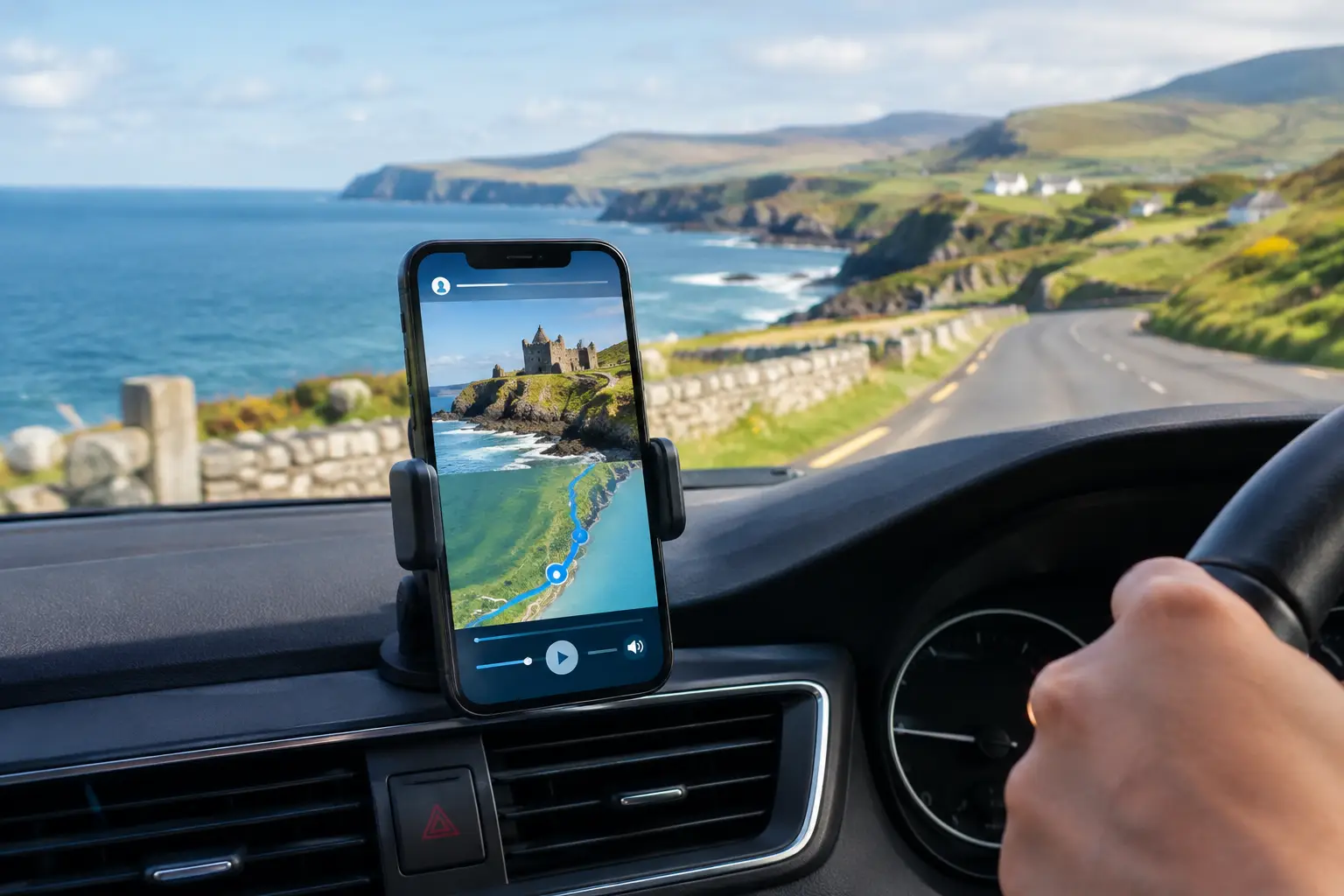
You have just left a village café, the road opens towards a headland and a castle sign appears at the next turn. This is where understanding how GPS audio tours work can make an independent Irish drive feel less like following a map and more like travelling with useful local context in your pocket. The app recognises where you are on the route and can play a short introduction when you approach a selected sight, leaving you free to decide whether to stop, carry on or return later.
A GPS audio tour is not a live guided excursion and it does not set a rigid timetable. It is a self-guided travel tool that combines a planned driving route, mapped points of interest and location-triggered audio. For visitors using car hire, it can be a practical middle ground between travelling entirely unaided and booking a group tour.
What a GPS audio tour actually does
At its simplest, a GPS audio tour uses your phone’s location services to compare your position with the route and places included in a tour. When you move close to a featured point, the app can prompt or automatically play a concise audio introduction about what is nearby.
That introduction might explain why a coastal viewpoint is worth pulling in for, give context to a historic abbey, or point out a landscape that could otherwise pass by as another beautiful stretch of road. The purpose is not to deliver a lengthy lecture at every mile. It is to help you notice the places that give a journey through Ireland its character.
The route map also helps you orientate yourself. Rather than searching for every attraction individually, you can see suggested stops as part of a wider driving day. This is particularly helpful on scenic routes, where a small detour may lead to a harbour, beach, viewpoint or heritage site that was not on your original list.
How GPS audio tours work while you are driving
Before setting off, download the free MyDriveTour app and choose and activate the tour that matches your itinerary. A paid tour provides access to its route, suggested stops and associated audio content. It is sensible to download the tour while you have dependable Wi-Fi, then check that your phone has sufficient battery and that location permissions are enabled.
Once the tour is open, GPS identifies your location as you travel. The app uses that position to show your progress and recognise when you are near one of its selected points of interest. Depending on the tour and your settings, commentary may begin automatically or be available for you to play when ready.
For the best experience, connect your phone to your vehicle’s hands-free system if available, or use a suitable mount and keep the phone safely out of your hands. Set everything up before moving off. Your attention should remain on the road, especially on Ireland’s narrow rural lanes, changing weather and routes shared with walkers, cyclists and farm traffic.
GPS is useful, but it is not magic. Signal and location accuracy can vary in remote valleys, among high cliffs or on roads with several close junctions. A sensible traveller treats the app as a helpful companion, watches road signs and follows any temporary diversions or safety directions encountered along the way.
Route guidance and commentary are related, but different
Many travellers expect every audio tour to behave exactly like a sat-nav. In practice, route guidance and sightseeing commentary are two separate jobs that work best together. Navigation helps you stay on the intended road; audio adds the story and significance of selected places.
A good self-guided tour presents both clearly, but it cannot account for every real-world change. A road closure, a packed car park, a sudden rain shower or a child who needs a break may alter your plan. That flexibility is one of the main advantages: you can adjust the day without having to catch up with a coach or group.
What happens when you reach a suggested stop
A suggested stop is an invitation, not an obligation. When the map shows a historic site, village, viewpoint or attraction, you choose whether it fits your time, interests and the conditions on the day. You may stop for five minutes to take photographs, spend an hour exploring, or save it for another morning.
The audio gives enough background to make an informed choice. For instance, you may learn that a ruin has an unusual local story, that a beach is known for its scenery, or that a town makes a useful place for refreshments. If a place catches your interest, you can then explore it at the depth you prefer.
This matters on a holiday where no two travellers want the same day. Families may prioritise open spaces and short walks. Couples might linger at a coastal viewpoint. A repeat visitor may skip the headline attraction and explore smaller towns instead. The route provides structure, while the order and pace remain yours.
Do allow for practical limits. Not every attraction is open every day, parking can be limited in popular areas and access conditions change with the season. Check current visitor information directly before building a fixed plan around a particular site. The app can point you towards worthwhile places, but it cannot guarantee admission, weather or a space in the car park.
Why the audio is kept short
On a driving holiday, the best commentary often arrives in useful, manageable pieces. Long recordings can distract from the road or leave little room for conversation, music and the simple pleasure of looking out at the landscape. Short introductions are designed to give you a reason to look closer without filling every moment of the drive.
That approach also respects the difference between a self-guided app and an in-person guide. A professional guide can answer questions, adapt their commentary in real time and offer detailed interpretation. GPS audio tours cannot do that. What they can do is provide convenient location-based prompts and concise stories at a lower-cost, self-paced alternative for independent travellers.
Getting the most from an Irish GPS audio tour
The most enjoyable way to use a tour is to regard it as a framework for the day, not a checklist to complete. Look over the route and stops in advance, choose two or three places you would particularly regret missing, then leave time for unexpected discoveries. A roadside market, a quiet pier or a change in the light along the coast can be as memorable as a planned landmark.
Keep your charging cable in the car, download content before heading into rural areas and start the tour before leaving your accommodation or a town with good reception. If you are travelling with someone else, let them manage the map and audio where possible. They can see what is ahead and decide whether the next suggested stop suits the day.
MyDriveTour is designed for this style of travel, with GPS-guided routes, suggested sightseeing stops and short audio introductions at selected Irish sights. It suits visitors who want helpful direction and context while keeping control of their own schedule. If you are covering several regions, the MyDriveTour All Tours bundle may make more sense than selecting tours one by one; if your trip focuses on one famous drive, an individual self-guided Ireland route is usually the simpler choice.
When a GPS audio tour may not be the right fit
A self-guided audio tour works best for travellers who are comfortable driving themselves and making their own decisions along the way. It may be less suitable if you want door-to-door transport, detailed historical discussion, help with access arrangements or a guide who can change plans instantly around your needs.
It also depends on your travel style. If you have only a few hours in a city centre, walking with a local guide may offer more depth. If you are spending several days crossing Ireland by car, however, GPS-based commentary can add useful structure without taking away the freedom that made you choose a road trip in the first place.
The real value is not in hearing audio for its own sake. It is in arriving at a place, understanding why it matters and having the freedom to make that moment your own.
