
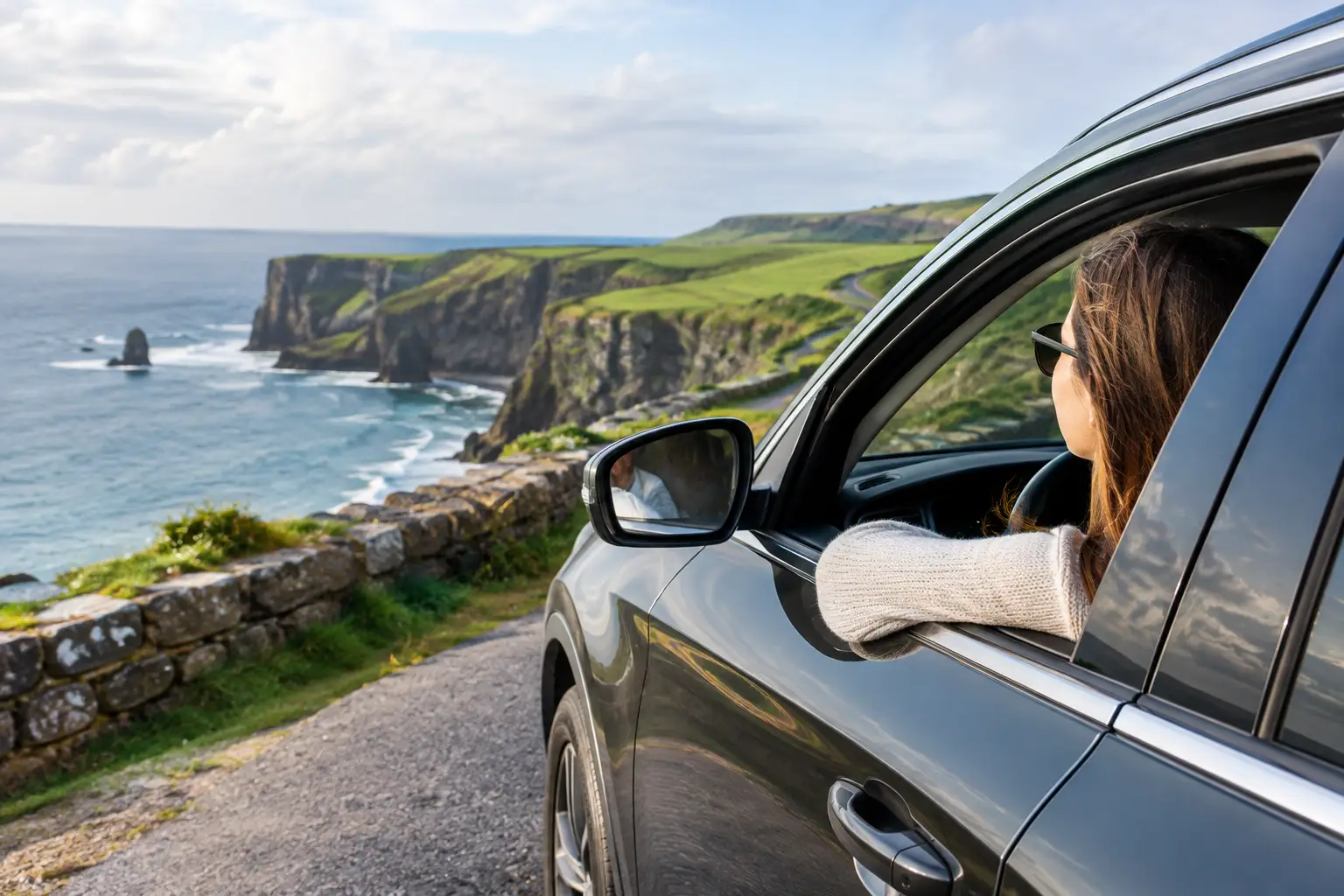
The best car hire decision is rarely about choosing the cheapest headline rate. On an Irish holiday, it is about arriving at the collection desk knowing what is included, selecting a car that suits the roads you will actually drive, and avoiding a nervous first hour behind the wheel. This car hire Ireland guide focuses on those practical choices, so your self-drive trip can begin with confidence.
Car hire Ireland guide: choose for your route
Ireland is wonderfully suited to independent travel, but its roads vary greatly. Motorways and main national roads connect airports, cities and larger towns efficiently. Once you turn towards a coastal peninsula, mountain pass or village lane, the road may become narrower, more winding and slower than it appears on a map.
For two travellers with light luggage, a compact car is often the sensible choice. It is easier to position on narrow roads, simpler to park in historic towns and usually more economical on fuel. A small car does not mean missing the scenery – it can make relaxed driving more achievable when the road has stone walls, hedgerows or oncoming traffic close by.
A larger vehicle may be worthwhile for a family, a group sharing luggage, or anyone carrying walking equipment. The trade-off is manoeuvrability. Before booking, consider not only how many people will be in the car, but also the size of your cases and whether each person is comfortable entering and leaving a larger vehicle on confined rural roads.
Automatic cars are popular with visitors who are not used to driving on the left. They are also limited in supply compared with manual vehicles, particularly in busy travel periods, so reserve early if an automatic is essential. If you are comfortable with a manual car, check where the gearstick, indicators and windscreen wipers are before leaving the car park. Familiar controls make the first few miles less distracting.
Look beyond the advertised daily rate
Car hire pricing can look straightforward until insurance, deposits and optional extras are added. The booking confirmation should set out the key details, but it is worth reading the hire company’s terms before you travel rather than trying to interpret them at the counter after a flight.
The most useful questions are simple. What insurance is included? What excess remains if the car is damaged or stolen? Is there a security deposit or card pre-authorisation? What is the fuel policy? Are there charges for an additional driver, young driver, child seat, or collection outside usual desk hours?
The excess is especially worth understanding. It is the amount for which you could remain responsible in the event of damage, subject to the hire agreement. Some travellers choose an excess-reduction option through the hire company; others arrange separate cover. Neither approach is automatically better. Compare what is covered, any exclusions, the claims process and whether you would need to pay the hire company first.
Use a credit card in the lead driver’s name where the company requires one, and make sure it has enough available credit for the stated deposit. A booking paid for in advance does not always remove the need for a deposit at collection. If more than one person may drive, add them properly to the agreement. Handing the keys to an uninsured friend or partner is a poor shortcut.
At collection: take ten calm minutes
After a flight or ferry crossing, it is tempting to sign, load the boot and leave. A brief check at collection can prevent confusion later. Walk around the vehicle with a member of staff if possible, and ensure existing marks are recorded. Photograph the exterior, wheels, windscreen and interior in good light. Pay particular attention to alloys, tyres and the lower edges of bumpers, where minor scrapes can be easy to miss.
Ask how to operate the lights, fuel cap, demister and reverse gear before pulling away. Confirm the fuel type and the return level required. Many modern cars use a button or electronic brake rather than a handbrake lever, so a quick demonstration is useful.
You should also understand what happens if you have a breakdown, puncture or minor collision. Keep the hire company’s contact details and your agreement accessible, rather than buried in a suitcase. For an emergency requiring police, fire or ambulance services in Ireland, call 112 or 999.
Driving in Ireland without unnecessary stress
In the Republic of Ireland, speed limits and distances are generally shown in kilometres. In Northern Ireland, signs use miles. If your itinerary crosses the border, take a moment to reset your expectations, especially when reading speed signs and estimating journey times.
Drive on the left, give way as signs and road markings require, and approach roundabouts carefully. Traffic circulates clockwise, so vehicles coming from the right have priority unless signs indicate otherwise. For drivers accustomed to right-hand traffic, roundabouts can feel unfamiliar at first. It helps to slow down early, choose the correct lane where marked, and follow the directional signs rather than making last-second decisions.
Rural roads deserve patience. A route may be technically two-way yet feel comfortably wide for only one car at a time. Slow down, watch ahead for passing places and be prepared to reverse a short distance if you are closer to one. Avoid stopping in a narrow bend for photographs, however beautiful the view. Pull into a safe designated area or a proper lay-by.
Weather can change quickly, particularly along the coast and in upland areas. Rain, low cloud and strong winds affect visibility and stopping distances. Leave more space than you would on dry roads, use dipped headlights when conditions demand it, and do not rely on a sat-nav’s arrival time as a reason to hurry.
Build an itinerary with room to stop
A scenic Irish drive is not improved by filling every hour with destinations. A route that looks short can include slow village traffic, single-track sections, photo stops, cafés, walks and a castle or beach that deserves longer than expected. Treat travel time as driving time, then add a generous allowance for everything that makes the day memorable.
This matters particularly on celebrated routes such as the Ring of Kerry, the Causeway Coast or stretches of the Wild Atlantic Way. The main attraction is often the journey between the headline sights: a harbour, a viewpoint, a quiet beach or an unexpected ruin. A modest daily plan gives you permission to stop when something catches your eye.
Navigation is helpful, but it should support rather than dictate the day. Download offline mapping where possible, carry a charging cable and keep an eye on fuel in remote areas. Do not assume every small village has late-opening petrol stations, especially outside larger towns. Filling up when the tank reaches around half full can remove one needless worry from a rural day out.
For travellers who would like route guidance alongside ideas for worthwhile stops, MyDriveTour is a self-guided app with GPS-guided routes, suggested sightseeing stops and short audio introductions at selected places of interest. The app download is free; individual tours and the All Tours bundle are paid options. It works best as a practical companion for travellers who want direction and local context while retaining complete control over their schedule, rather than as a substitute for an in-depth professional guide.
Tolls, parking and crossing the border
Some Irish roads have tolls, so check your planned route and ask the hire company how its toll arrangements work. The M50 around Dublin requires particular attention because it uses a barrier-free tolling system. Depending on the vehicle and hire agreement, payment may be handled by the hire company, passed on with an administration charge, or require action from the driver. Confirm the process at collection and keep any relevant documentation.
Parking rules are local, and town centres often use pay-and-display machines, parking apps or clearly marked bays. Read signs carefully, especially around loading areas, bus stops and spaces reserved for permit holders. In popular visitor areas, arriving earlier in the day can be more valuable than circling for the closest possible space.
If your trip includes both the Republic of Ireland and Northern Ireland, tell the hire company before booking or collecting. Cross-border travel is commonly possible, but conditions, documentation and fees can vary by provider. You will also want to check that any navigation settings and travel insurance details are suitable for the full route.
Return the car with a little breathing space
The return day can be more rushed than expected. Allow time to refill the tank if required, remove all belongings and photograph the vehicle again. Check door pockets, boot compartments, charging ports and under the seats – passports, sunglasses and children’s toys are regular casualties of a hurried return.
Keep the final receipt and any condition report until the hire is fully closed. If you notice damage during the trip, report it promptly and follow the company’s instructions. Clear communication is far easier than hoping a small issue will go unnoticed.
A well-chosen hire car gives you the freedom to follow a coastal road, pause for a village lunch or take the longer route simply because the landscape looks inviting. Leave space in the plan, drive to the conditions and let Ireland reveal itself one unhurried stop at a time.
