
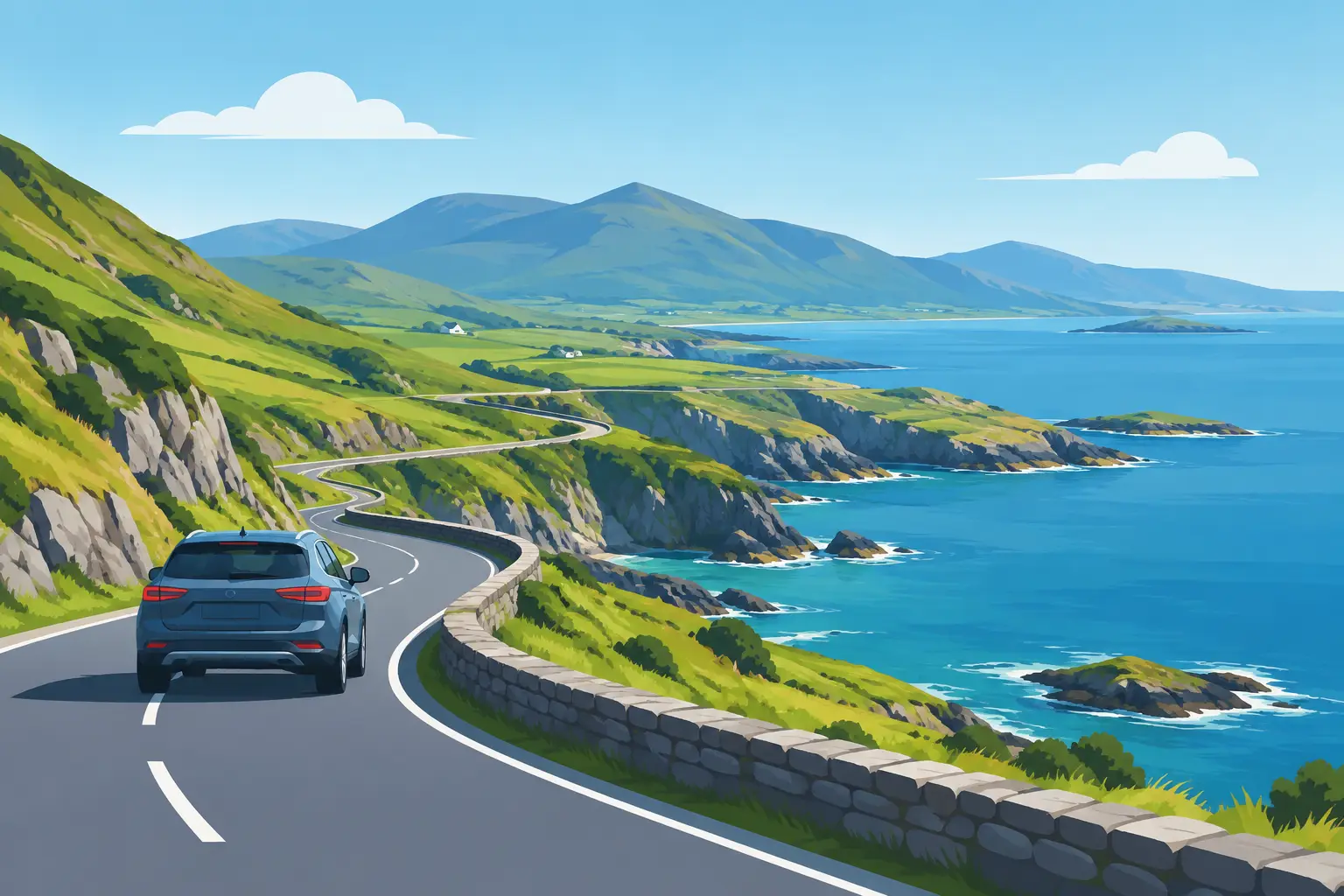
The Ring of Kerry driving route is not a journey to rush between breakfast and dinner. This famous 179-kilometre circuit has mountain passes, Atlantic bays, lakes, beaches, villages and viewpoints that reward a little patience. With a sensible plan, it becomes one of the great self-drive days in Ireland rather than a long sequence of missed turn-offs and crowded car parks.
For independent travellers, the real pleasure is choosing the pace. You can follow the full circuit, take a quieter detour, stop for a walk when the weather clears, or pass by an attraction that does not suit your day. A guide-led route on your phone helps make those decisions feel easy, while still leaving the holiday in your hands.
Which way should you drive the Ring of Kerry?
Most visitors begin and finish in Killarney, driving clockwise through Killorglin, Cahersiveen, Waterville, Sneem and Kenmare before returning through Killarney National Park. This direction follows the standard route used by many organised coaches, which means you are less likely to meet large vehicles on the narrowest sections of road.
There is, however, a trade-off. Clockwise is the practical choice, but it can put you alongside other visitors at the best-known stops. An early start makes a considerable difference. Leave Killarney around 8.00am in high season and you can enjoy the first part of the route before the busiest period begins.
Anti-clockwise can work for confident drivers travelling outside the main summer months, particularly if you want to reach Kenmare or Sneem first. Yet some roads are tight, winding and bordered by stone walls. For a first visit, clockwise remains the straightforward option.
Give the route a full day
On paper, the Ring of Kerry can look manageable in three and a half to four hours of driving. In practice, that only accounts for time behind the wheel. Add scenic pull-ins, photo stops, lunch, short walks and traffic, and you have a full-day outing.
Allow at least seven hours if you want to see the principal highlights without feeling hurried. Eight to ten hours is better for travellers who would like to include a detour, visit an attraction or spend time in Killarney National Park at the end of the day. Families should also allow for regular breaks – the views are spectacular, but younger passengers may not share the same enthusiasm for a continuous coastal drive.
The weather is another reason to retain flexibility. Kerry can give you low cloud, sunshine and a sharp shower in the same afternoon. Do not abandon a viewpoint simply because the first view is grey. A coffee stop or a short walk can transform the conditions by the time you return to the road.
The best stops on the Ring of Kerry driving route
Killarney National Park, Ross Castle and Ladies View
Starting from Killarney places lakes and woodland at either end of the circuit. Ross Castle is an easy early stop if you have time before leaving town, while Muckross House and its gardens can suit visitors who want to combine scenery with local history.
Ladies View is one of the most celebrated lookouts in the area, named after Queen Victoria’s ladies-in-waiting, who admired the panorama during the royal visit of 1861. It overlooks the lakes of Killarney and the surrounding mountains. It is popular for good reason, so park carefully and expect company in summer.
Moll’s Gap and the road towards Kenmare
Moll’s Gap offers a high, open landscape of rugged hills and sweeping road bends. It is not the place to hurry or to stop suddenly for a photograph. Use designated lay-bys, watch for cyclists and sheep, and give yourself time to take in the view safely.
The descent towards Kenmare brings you into a livelier market town with colourful shopfronts, cafés and restaurants. It is an excellent lunch stop, although it may make more sense later in the day if you are following the standard clockwise circuit. If you prefer a gentler first day in Kerry, a Killarney to Kenmare drive with a return through the park can be a satisfying alternative to completing the entire loop.
Sneem and the south-west coast
Sneem is a welcoming village positioned between mountains and the sea. Its compact centre is suited to a stretch of the legs, a light lunch or a look at the colourful buildings and small public sculptures. It is also a useful point to reassess your timing before continuing towards Waterville.
Beyond Sneem, the road reveals some of the Ring’s finest coastal scenery. The landscape feels more remote, with islands, inlets and distant headlands appearing between bends. This is where an audio-guided tour adds genuine value: it can explain the stories behind the place without asking the driver to read a screen or search for the next point of interest.
Waterville and Ballinskelligs Bay
Waterville sits between the Atlantic and Lough Currane, with the Iveragh mountains behind it. It is well known for its connection with Charlie Chaplin, who holidayed here for many years, but its appeal extends beyond that famous visitor. The promenade, beach and open views make it a worthwhile stop even on a busy day.
A detour towards Ballinskelligs is one of the best choices for travellers with extra time. The bay has a broad beach and the ruins of Ballinskelligs Castle stand near the shore. Skelligs Chocolate, just outside the village, is a popular optional stop. The detour adds time, so it is better enjoyed by those starting early or splitting the Ring of Kerry across two days.
Cahersiveen, Valentia Island and Portmagee
Cahersiveen is a good base for exploring one of the route’s most rewarding side journeys. From here, you can continue towards Portmagee and cross to Valentia Island. The island has dramatic cliffs, Atlantic views and places of real geological and maritime interest.
This is not a small add-on. Valentia Island deserves several hours if you want to explore rather than simply drive across it. If your priority is completing the full Ring before dark, save it for a separate day. If your holiday allows it, staying nearby gives you the freedom to see the island at a calmer pace.
Drive with care on Kerry roads
The roads are part of the experience, but they demand attention. Many sections are narrow and winding, with limited visibility around bends. Drive on the left, reduce speed well before sharp corners and use passing places considerately where they are available.
Sheep, walkers, cyclists and occasional farm vehicles all belong on these roads. Do not rely solely on the speed shown by a navigation app. Conditions, weather and traffic should determine your speed, especially on mountain sections.
Fuel up before setting out from Killarney, Kenmare or another larger town, and keep water, snacks and a light waterproof layer in the car. Mobile signal can vary in rural areas, so download maps and tour content before you leave accommodation. A charged phone and in-car charging cable are simple essentials for a route built around navigation.
Make the day yours with MyDriveTour
A self-guided tour should remove the research burden without turning your holiday into a timetable. MyDriveTour combines a professionally planned route with turn-by-turn navigation and automatic audio commentary that plays as you reach points of interest. You can start where it suits you, choose the stops that appeal and discover the local stories that can otherwise pass unnoticed from the car window.
It is particularly useful on the Ring of Kerry, where the famous highlights are only part of the story. The right commentary can give context to an old bridge, a ruined settlement, a mountain view or a quiet village, while practical attraction information helps you decide whether a stop is worth your time.
Leave space in the day for an unplanned pause. The most memorable moment on the Ring of Kerry may be a well-known viewpoint, but it can just as easily be sunlight across a quiet bay, a warm welcome in a village café or a road you chose to follow a little further.
