
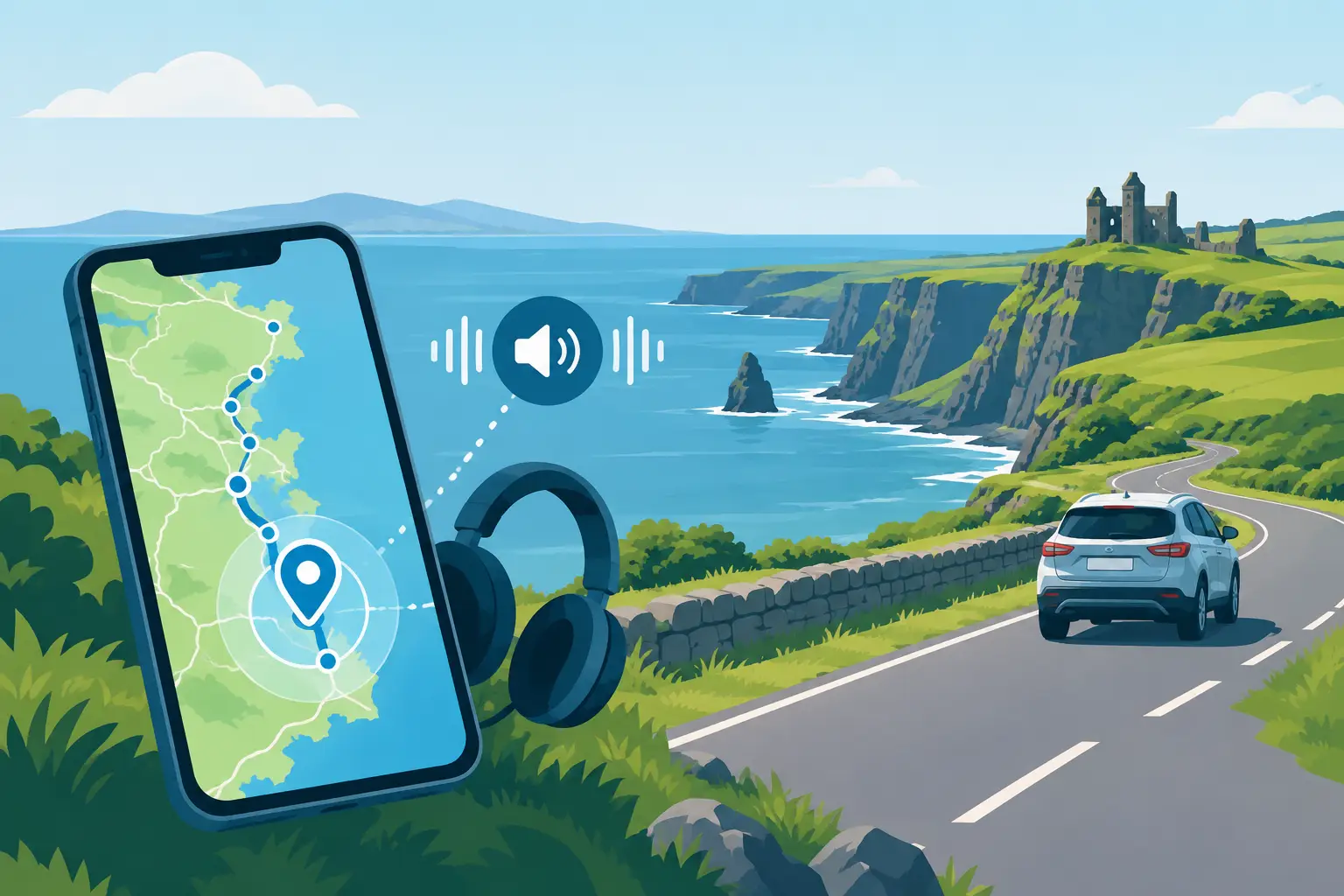
Ireland’s best touring moments rarely arrive on a timetable. They happen when the road opens onto a wide Atlantic bay, a ruined abbey appears behind a stone wall, or a small village café looks too good to pass. A geofenced audio guide Ireland travellers can use turns those unplanned moments into a better-informed holiday, without asking everyone in the car to stare at a screen.
For independent visitors, that matters. A self-drive holiday offers freedom, but it can also leave you wondering what you have just passed, whether a viewpoint is worth the detour, or how to fit the major sights into a realistic day. Geofenced audio gives you the feeling of travelling with a knowledgeable local guide, while leaving the timing and pace entirely in your hands.
Why a geofenced audio guide for Ireland works
Geofencing uses your phone’s location to recognise when you are approaching a particular place. As you arrive near a viewpoint, heritage site, town or hidden local landmark, the relevant audio commentary begins automatically. Rather than pressing play on a long recording and trying to match it to the road, you hear the right story when the landscape in front of you makes it meaningful.
That simple difference is especially useful in Ireland. Touring routes can move quickly between dramatic coastlines, historic estates, colourful market towns and quiet rural roads. The Ring of Kerry, Wild Atlantic Way, North Antrim Coastal Drive and Sunny Southeast all reward curiosity, but they also contain more potential stops than most visitors can fit into one trip.
A location-aware guide helps provide context at the moment it is needed. You may hear why a headland was important to mariners, how a castle shaped the surrounding community, or what makes an apparently ordinary village a place worth pausing. The story becomes part of the view rather than something you read later in a guidebook.
Keep your eyes on the road, not on a screen
A great Irish drive deserves attention. Narrow lanes, changing weather, cyclists, wandering livestock and scenic bends all require a driver to stay alert. Reading directions and searching for background information while travelling is not just inconvenient – it takes attention away from the journey.
Automatic audio commentary reduces that pressure. Your phone can remain safely positioned, while navigation is handled through your preferred mapping app and the guide adds commentary as you reach each point of interest. Passengers still have plenty to enjoy, but nobody needs to act as a full-time researcher or navigator.
This is not a replacement for sensible driving. Audio should be kept at a comfortable volume, and the driver should never attempt to operate the app while moving. It is, however, a practical way to make long touring days feel calmer. Instead of constantly asking, “What is that?” or “Did we miss the stop?”, you can let the journey reveal itself as it unfolds.
More than directions between famous attractions
Most visitors already know about the Giant’s Causeway, the Cliffs of Moher or Killarney National Park. The challenge is making sense of everything around those headline locations. Which road offers the better views? Where can you stop without turning a simple outing into an exhausting day? What else nearby deserves your time?
A well-designed audio tour should combine the famous places with the stories and smaller discoveries that give a region character. That could mean a coastal lookout with a surprising connection to local history, a lesser-known harbour, an early Christian site, or a village that makes a worthwhile lunch stop.
This is where qualified guides and experienced chauffeurs add real value. They understand not only the landmark itself, but how visitors experience it on the ground. They know where the road narrows, which stop suits a family with limited time, and when a detour is genuinely rewarding rather than simply adding miles.
MyDriveTour brings that local touring knowledge into an app-led format, giving independent travellers a practical route structure alongside stories that make each region more memorable.
Choose your own pace without losing the local insight
A coach tour can be convenient, but it follows a fixed schedule. A private chauffeur offers exceptional comfort, yet it may not suit every budget or holiday style. A geofenced audio guide sits comfortably between those two options.
You decide when to begin, how long to stay, and which stops appeal most. Spend an extra hour on a beach walk if the weather is kind. Skip an attraction if the family would rather have a relaxed lunch. Start from a different point on the route if that is where you are staying. The guide remains useful because the commentary is triggered by where you are, not by a group timetable.
That flexibility is valuable for couples, families and friends with different interests. One person may want the archaeology behind a stone fort, while another is more interested in a photo stop or local food. A self-guided format leaves room for both, without making anyone feel rushed through a place they wanted to enjoy.
Plan for a smoother touring day
The best experience begins before you set off. Download your chosen tour and review the route while you have a reliable connection, ideally before leaving your accommodation. Check that location services are enabled and allow the app to send notifications or play audio as required by your phone settings.
It is also wise to export the route to your preferred mapping app before starting the drive. This keeps navigation familiar and gives you a clear picture of journey times. Irish touring roads can take longer than they appear on a map, particularly on coastal sections or rural routes where you will naturally want to stop.
A few small preparations make a difference:
- Charge your phone fully and bring a car charger, especially for a full day on the road.
- Download any available route material before entering areas with patchy mobile coverage.
- Build in time for parking, walks, cafés and viewpoints rather than planning every minute around driving time.
- Check attraction opening times when a particular site is essential to your day.
The technology should support spontaneity, not create another task list. Think of the route as a confident starting point, then leave space for the moments that cannot be scheduled.
What geofencing can and cannot do
Location-triggered audio is highly useful, but it is not magic. GPS accuracy can vary in dense streets, wooded areas, deep valleys or poor weather. If you travel very quickly past a point, you may hear only part of a commentary. If you take a substantial detour, the next audio trigger will naturally arrive later than expected.
That is why a good tour needs more than a collection of pins on a map. It needs thoughtful route design, well-paced commentary and clear stop information. The audio should add to the drive rather than interrupt it too often, particularly on busier sections of road.
Mobile signal is another consideration. Ireland has excellent coverage in many areas, but remote coastal and mountain stretches can still be inconsistent. Downloading content in advance gives you greater confidence. It also means your experience does not depend on a signal appearing at precisely the right moment.
For travellers who prefer a fully guided day, have mobility requirements, or simply do not wish to drive, a chauffeur-driven tour may be the better choice. For everyone else, geofenced audio offers an appealing balance: guided expertise, personal freedom and the chance to experience Ireland as more than a series of car parks.
Let the road tell the story
Ireland is not best experienced by racing between a checklist of famous names. Its character is found in the distance between them: the changing fields, the old bridges, the place names, the local legends and the unexpected views that make you pull over.
Choose a route that suits your holiday, give yourself more time than you think you need, and let a geofenced guide introduce the stories waiting just beyond the next bend.
