
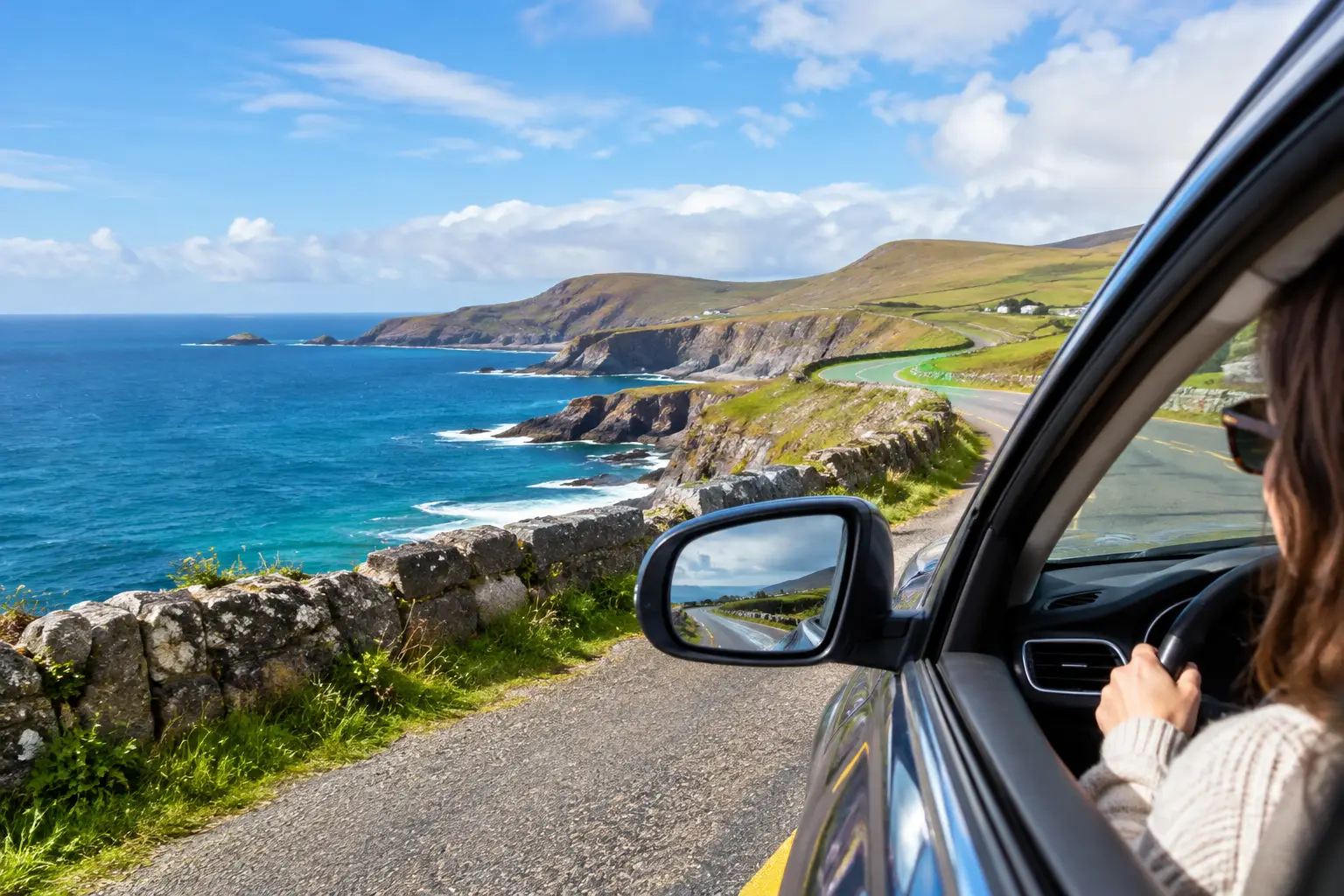
Ireland’s best Irish coastal viewpoints are rarely reached by a single straight road. They appear after a bend in a headland route, at the end of a short walk from a car park, or beside a small harbour where the Atlantic seems close enough to touch. For independent travellers, that is part of the pleasure: you can stop for ten minutes, stay for an hour, or change your plan when the light turns spectacular.
The locations below work particularly well on a self-drive holiday because they offer a rewarding view without requiring a major hike. Conditions matter, though. Coastal roads can be narrow, winds can be fierce and cloud can erase a view in moments. Leave room in your day for unplanned stops, and never park in a passing place or on the verge.
The best Irish coastal viewpoints for a self-drive holiday
1. Slieve League, County Donegal
Slieve League is one of Ireland’s most dramatic cliff landscapes, with sheer slopes falling towards the Atlantic and vast views along Donegal’s rugged south-west coast. The approach itself is memorable, passing through a remote landscape of bog, sheep fields and low mountains.
There are viewpoints near the visitor area for travellers who want a shorter stop, while the clifftop routes suit confident walkers with suitable footwear. Wind and low cloud can transform the experience, so treat clear weather as a bonus rather than a guarantee. It is a superb choice if you prefer a wilder, less polished coastal setting.
2. Malin Head, County Donegal
At Ireland’s northernmost point, Malin Head feels exposed in the best possible way. From Banba’s Crown, the view opens over dark rock, restless sea and the distant northern horizon. On a clear day, it has a real edge-of-the-map feeling.
This is a worthwhile detour for travellers following Donegal’s northern coast. Take your time on the final approach, as roads can be narrow and weather can change quickly. Bring an extra layer even in summer: this is not a place to judge conditions by the temperature in your car.
3. Downpatrick Head, County Mayo
Downpatrick Head delivers a classic west-coast scene: high grassy cliffs, sea stacks and the striking Dun Briste stack standing just offshore. It is an accessible place to pause when travelling around north Mayo, particularly for visitors who want big Atlantic views without committing to a long coastal walk.
Keep well back from cliff edges and follow any safety information on site. The ground can be uneven and gusts are common. Photographers often favour early or late light, but even a grey day gives the sea stack a powerful, brooding presence.
4. Keem Bay, Achill Island
The road down to Keem Bay is an attraction in its own right. Its hairpin bends reveal a sheltered crescent of pale sand, clear water and steep green slopes rising on either side. Compared with Ireland’s towering cliff viewpoints, Keem feels intimate and unexpectedly colourful.
Drive slowly and be prepared to meet oncoming traffic on the descent. The bay is especially appealing when you want to combine a scenic drive with time by the water. In busier periods, arriving earlier in the day makes the stop feel more relaxed.
5. Cliffs of Moher, County Clare
The Cliffs of Moher are among the country’s most recognisable coastal sights for good reason. Their long wall of rock rises above the Atlantic, with views stretching along the Clare coast and, when visibility allows, towards the Aran Islands.
They can be busy, particularly in the middle of the day and during school holidays. That does not make them a stop to skip, but it does reward a little planning. Visit early or later if your itinerary allows, stay within designated paths and allow time to enjoy the changing views rather than only taking a quick photograph.
6. Loop Head, County Clare
For a quieter contrast to the Cliffs of Moher, continue west towards Loop Head. The coastal drive is peaceful, open and full of small moments: stone walls, fields reaching towards the sea and occasional views across the Shannon Estuary.
Near the headland, the outlook is broad rather than vertical. You are looking across water that connects Clare and Kerry, with the lighthouse adding a strong focal point. This is an excellent choice for travellers who value space, slower roads and a less crowded coastal stop.
7. Slea Head, Dingle Peninsula
Slea Head is one of the great viewpoints on the Wild Atlantic Way. The road wraps around the western edge of the Dingle Peninsula, bringing the Blasket Islands into view beyond a series of cliffs, beaches and stone-built fields.
The route is best enjoyed without rushing. You will want time for pull-ins, short walks and viewpoints that may not have appeared on your original list. Some stretches are narrow, so drive with care and be considerate of local traffic, cyclists and walkers. The sea view is the headline, but the layers of island, hillside and farmland make it special.
8. Geokaun Mountain, Valentia Island
Valentia Island offers a different perspective on County Kerry’s coast. From Geokaun Mountain, the view looks across the island’s patchwork fields towards the mainland, the Dingle Peninsula and the Skellig coast. It gives you height without the sense of standing on an exposed Atlantic cliff.
It is a particularly satisfying addition to a Ring of Kerry itinerary if you have time to step away from the main route. The island setting also encourages a slower pace, with small roads, harbour views and the sense that you have found a quieter corner of the peninsula.
9. Mizen Head, County Cork
At Mizen Head, the south-west coast becomes narrow, rocky and intensely dramatic. A deep gorge separates the mainland from the headland, while the ocean crashes through the channels below. The views here feel engineered by geology rather than arranged for visitors.
This stop takes commitment if you are travelling from elsewhere in Cork, but that is why it works so well for a dedicated west Cork day. Check local visitor arrangements before setting out, especially outside the main season, and give yourself time to enjoy the drive as well as the headland.
10. Old Head of Kinsale, County Cork
The Old Head of Kinsale is a striking headland on Ireland’s south coast, where green farmland narrows towards steep cliffs and open water. The journey around this area is scenic in a gentler way than the Wild Atlantic Way’s most remote corners.
Public access around the headland is limited in places, so it is best viewed as a scenic drive with selected stopping points rather than a destination for a long walk. It pairs well with time in Kinsale, where colourful streets and harbourside dining offer a welcome change from the exposed coast.
11. The Copper Coast, County Waterford
Between Tramore and Dungarvan, the Copper Coast provides a geological coastline of coves, rocky inlets and wide sea views. It is ideal for travellers exploring Ireland’s south-east who want a coastal route that feels scenic but not overly remote.
Stops such as Bunmahon and Stradbally can break up the drive, but leave space to pull over wherever a safe viewpoint appears. This stretch suits families and couples who enjoy mixing short beach stops with a relaxed day of driving.
12. Mussenden Temple, County Londonderry
Perched above Downhill Strand on the Causeway Coast, Mussenden Temple is one of Ireland’s most memorable cliff-top scenes. The small circular building sits near the edge of a high promontory, creating a view that is both historic and cinematic.
It is easy to combine with other north-coast highlights, but avoid trying to fit too much into one day. Give the viewpoint time, especially if you want to walk the grounds and watch the weather move across the beach below.
Make coastal stops feel like part of the journey
The most rewarding coastal days usually combine one headline viewpoint with two or three smaller stops. Trying to see every famous cliff in one day can turn beautiful roads into a checklist. Instead, choose a region and let weather, daylight and your own energy decide how long you stay.
For travellers covering more than one coast, MyDriveTour can help keep the driving simple with GPS-guided routes, suggested sightseeing stops and short audio introductions at selected sights. The free app download lets you browse the experience, while paid self-guided tours suit visitors who want a ready-made route without giving up the freedom to choose their own stops.
Pack waterproof outer layers, comfortable shoes and something warm for every major viewpoint. Then, when a clearing appears over the Atlantic or the evening light reaches the cliffs, you will be ready to stop rather than simply drive past.
