
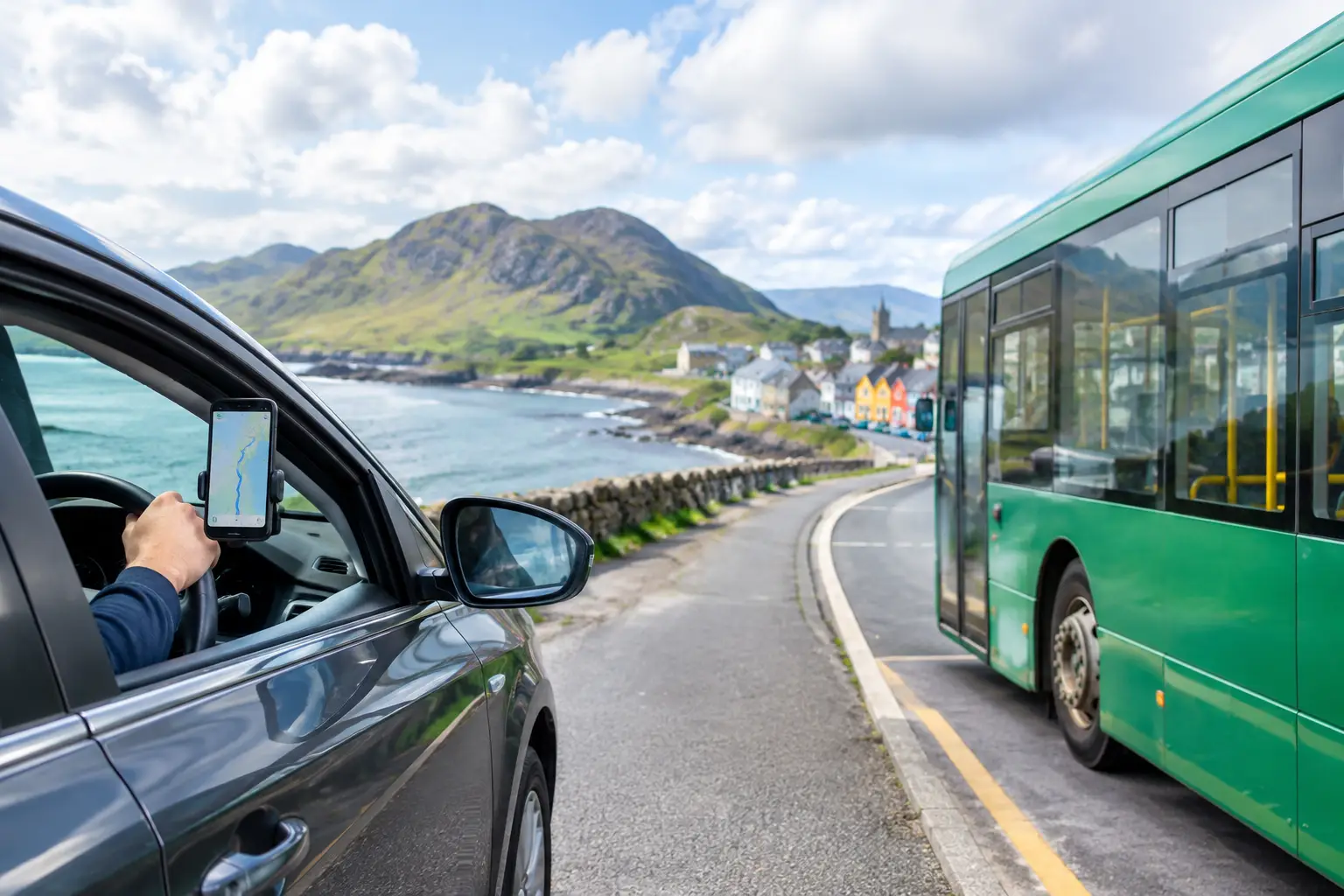
A train can bring you into Dublin, Galway or Killarney with little effort. But it cannot pause beside a windswept beach, take a detour to a ruined abbey or wait while you linger over lunch in a harbour village. That is the real question behind rental car versus public transport in Ireland: not simply which option is cheaper, but which gives you the sort of holiday you want.
For city breaks and straightforward point-to-point journeys, public transport can be an excellent choice. For travellers hoping to experience coastal roads, small towns and places beyond the main rail network, car hire usually changes what is possible in a day.
Rental car versus public transport: the practical difference
Ireland is compact on a map, yet its most memorable places are often spread across rural counties. Rail services connect several major towns and cities, while buses reach many more communities. They are useful, especially when you do not want to drive after a flight or when your itinerary centres on Dublin, Belfast, Cork, Galway or Limerick.
The limitation is timing. A bus route may pass a scenic viewpoint without stopping, run only a few times a day, or require a change in a town that is not part of your plans. Reaching a clifftop walk, a secluded beach or a historic site can also mean adding a taxi to the journey. Those extra connections are manageable, but they can make a short break feel dictated by timetables.
A rental car gives you control over the spaces between the headline attractions. You can leave early for a quiet coastal drive, stop when the weather clears, skip a busy attraction, or spend an unplanned hour in a village that catches your eye. For a couple, family or group, that flexibility is often the main value rather than the vehicle itself.
When public transport is the better choice
Public transport makes strong sense when you are staying in one or two well-connected places. Dublin is particularly easy to enjoy on foot and by local transport, and parking can be inconvenient and costly. If your plan is to spend several nights in a city, take a direct train to another city and join an organised day trip for the countryside, hiring a car for the whole holiday may add more responsibility than freedom.
It can also suit solo travellers who are happy to plan around scheduled services and want to keep costs predictable. You avoid fuel, parking, tolls and the need to become comfortable driving on the left. There is pleasure in looking out of the window rather than concentrating on unfamiliar roads.
Public transport is less suitable when accommodation is outside a town, when you are travelling with young children or significant luggage, or when your wish list includes several rural stops in one day. It is worth checking the exact connections before assuming a location is easily reached. A place may be only a short distance away by road but awkward to access without a car.
The cost question is not always simple
A bus or train ticket can be less expensive than car hire for one person travelling between major cities. Once two, three or four people are travelling together, the comparison can shift. Shared car-hire and fuel costs may be competitive with multiple tickets, particularly if the car replaces taxis at either end of a journey.
That said, a car has costs that should be considered honestly. Your budget needs room for the hire charge, insurance options, fuel, parking and any tolls on your chosen route. Automatic vehicles may cost more than manual cars, and availability can vary, so book the type you need in good time. Public transport can be the calmer financial choice if you are only making a handful of direct journeys.
When a rental car transforms the holiday
A car becomes especially worthwhile when the journey is part of the experience. The Ring of Kerry, the Causeway Coast, the Wild Atlantic Way and Ireland’s south-east are not merely routes from A to B. They are areas filled with viewpoints, heritage sites, beaches, gardens, cafés and small detours that reward an unhurried schedule.
Take the Ring of Kerry as an example. A public bus can show you a great deal of the peninsula, but it follows its own route and stopping pattern. With a car, you can decide whether to prioritise mountain views, a boat trip, a beach walk or time in Kenmare. The trade-off is that you must navigate narrow rural roads carefully and accept that summer traffic can slow the day down.
The same principle applies along the Causeway Coast. Major sights may be reachable by bus from Belfast or Derry, but a car gives you room to link them with smaller stops that do not fit neatly into a timetable. It also makes early starts and late-afternoon viewpoints much easier, often when the light is at its best.
Driving in Ireland: confidence matters
For visitors used to driving on the right, driving on the left deserves your full attention at first. Take a few quiet kilometres to settle in after collecting the car, particularly at roundabouts and junctions. Choose an automatic if it will make the adjustment easier, and avoid planning your longest drive immediately after an overnight flight.
Rural roads can be narrow, winding and slower than they appear on a map. Allow extra time rather than trying to fit every attraction into one day. Pull in only where it is safe and permitted, watch for walkers, cyclists, livestock and farm vehicles, and never stop in a passing place just for a photograph.
The best self-drive days have breathing room. Two or three meaningful stops, a good lunch and time for an unscripted discovery will usually feel more rewarding than racing through eight pins on a map.
A useful middle ground: combine both
You do not have to choose one form of transport for the entire trip. Many visitors arrive in Dublin without a car, explore the city for a few days, then collect one when it is time to head west, south or north. This approach avoids city-centre driving while preserving the freedom needed for rural Ireland.
Another sensible option is to hire a car for only the part of the holiday where it earns its keep. Use rail for a direct intercity journey, then collect a vehicle near your overnight base for two or three days of local exploring. It may reduce parking costs and means you are paying for a car only when it suits your plans.
If you choose to drive, a self-guided route can remove much of the uncertainty from the day. MyDriveTour is a self-guided app with GPS-guided routes, suggested sightseeing stops and short audio introductions at selected sights. The app download is free, while individual tours and the All Tours bundle are paid options. It is designed for travellers who want useful context and an organised route while remaining free to choose their own pace, stop order and time spent at each place.
Choose based on your itinerary, not a rule
Choose public transport if your holiday is centred on cities, direct rail journeys and a slower, low-planning pace. Choose a rental car if the places you most want to see are rural, coastal or scattered across a region. If your plans include both, combine the two and let each do what it does best.
Ireland rewards travellers who leave a little space in the day. Whether that space comes from a train timetable or an open road, use it for the village, viewpoint or conversation you could not have planned for.
