
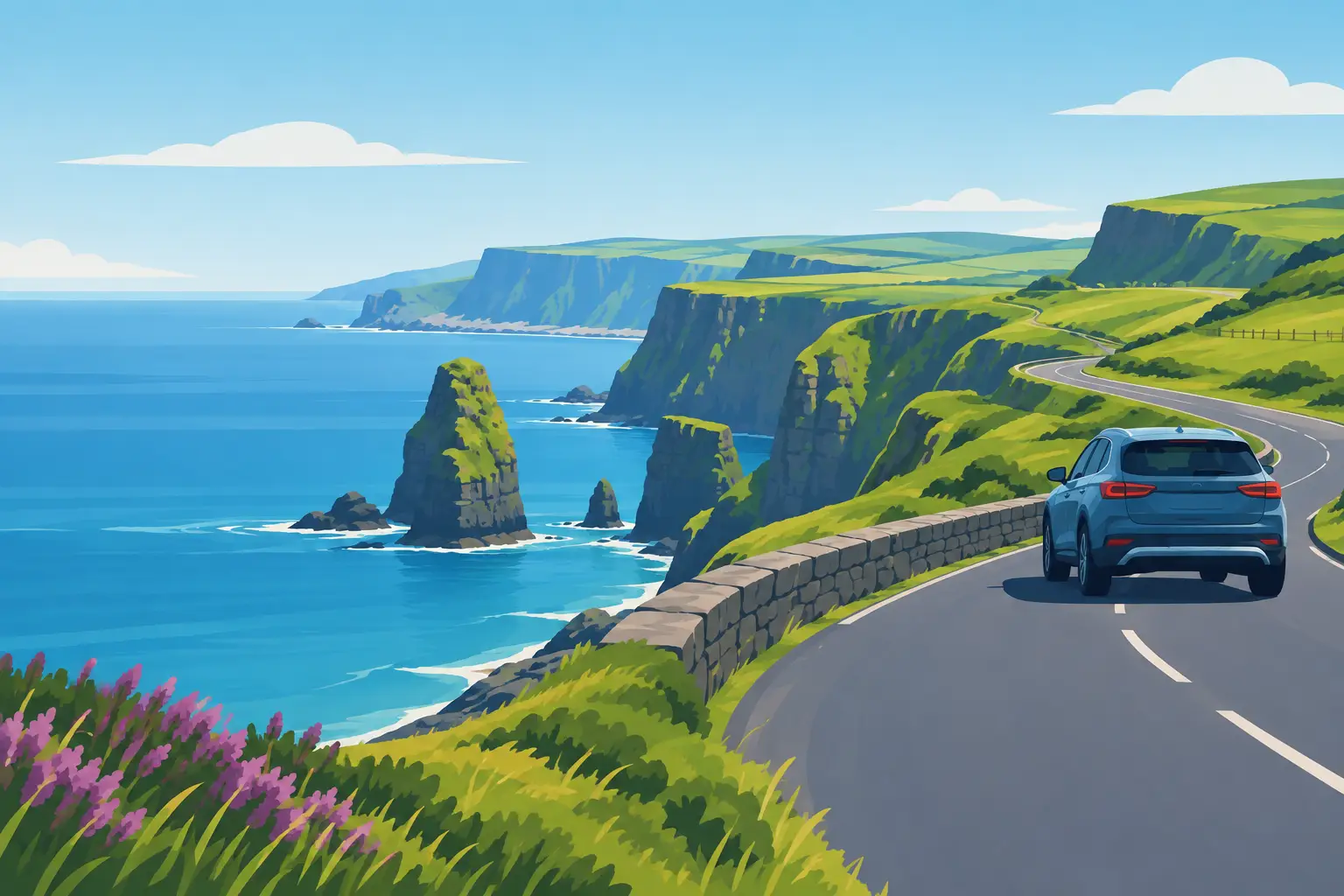
The North Antrim Coastal Drive itinerary is one of those rare road trips where the journey genuinely competes with the headline attraction. You may set out for the Giant’s Causeway, but it is the succession of sea cliffs, little harbours, glens and high, empty viewpoints that stays with you. The key is not trying to stop everywhere. Give the coast enough time, choose a handful of places that suit your interests, and let the road set the pace.
A North Antrim Coastal Drive itinerary that works
For most independent travellers, the best direction is from Belfast towards Portrush or Derry/Londonderry. This puts the sea on your right for much of the journey north from Larne, makes the views easier for passengers to enjoy, and builds naturally towards the Causeway Coast’s best-known landmarks. It also means you can finish near a wider choice of restaurants and accommodation.
A full coast-to-coast drive with every worthwhile detour can easily fill two days. If you have one day, concentrate on the stretch between Cushendun and Dunluce Castle, rather than attempting every stop between Belfast and Derry/Londonderry. Travellers staying in Ballycastle, Portrush or Bushmills can make an especially unhurried day of it. From Belfast, expect a long but rewarding day behind the wheel, particularly in summer when car parks and attractions take longer.
Set off early if you are travelling in peak season. The route is not difficult, but it is a scenic coastal road with changing speed limits, occasional narrow sections and plenty of reasons to pull over. Driving slowly is part of the experience, not a delay to it.
Morning: the Glens, Cushendun and Torr Head
Leaving Belfast, follow the coast through Larne and towards the Glens of Antrim. This first section establishes the character of the drive: green hills dropping sharply to the water, villages tucked into sheltered bays, and views across the North Channel towards Scotland on a clear day. Ballygally and Glenarm are pleasant early pauses if you want coffee, a walk or a glimpse of the historic Antrim coast before the scenery becomes more dramatic.
Cushendall makes a sensible comfort stop, with places to eat and a setting at the mouth of Glenballyemon. A little farther north, Cushendun feels more intimate, with whitewashed cottages, a small harbour and a village atmosphere that encourages you to leave the car for a few minutes. Its famous caves are a short walk from the village and are worth visiting for the coastal setting as much as their screen fame.
Is the Torr Head detour worth it?
For confident drivers with time to spare, Torr Head is one of the most memorable detours on the North Antrim coast. The route climbs above the sea and delivers wide, exposed views towards the Mull of Kintyre. It is not the quickest way north, however. Roads are narrow, steep and twisting in places, with limited room for passing, so it is better treated as a scenic excursion than an essential tick-box stop.
Skip Torr Head if you are short on daylight, uneasy on small roads, driving a larger vehicle, or travelling with passengers who dislike steep drops. Check your hire agreement before taking any remote coastal detours. The main coast road offers superb scenery without the added concentration. If you do go, take your time and never stop where you obstruct the road.
Midday: Ballycastle, Carrick-a-Rede and Ballintoy
Ballycastle is a practical place for lunch, fuel or supplies. The town looks across to Rathlin Island, whose outline is often visible offshore, and has a broad beach for anyone who would prefer a quiet coastal walk to another attraction visit. It is also a useful decision point: continue directly towards the Causeway, or allow time for the more rugged headlands beyond town.
Carrick-a-Rede Rope Bridge is one of the route’s classic experiences. The crossing itself is brief, but the cliff path and island views are the real reward. It can be busy and usually requires advance planning, particularly during school holidays and fine-weather weekends. If you do not have a timed visit, do not let it derail the whole day. Ballintoy Harbour nearby provides equally striking rock formations and a wonderfully wild seascape, with less pressure to keep to a schedule.
Continue through the Whitepark Bay area, where the coast opens into a long sweep of sand beneath grassy slopes. It is a beautiful place to admire from the road or viewpoint, but conditions on the beach can change quickly. Save a longer walk for another day unless you have deliberately kept your itinerary light.
Afternoon: Giant’s Causeway, Bushmills and Dunluce Castle
The Giant’s Causeway deserves proper time. The basalt columns are impressive in photographs, yet walking down to the shoreline reveals the scale and strange geometry of the landscape far better. Allow at least 90 minutes, more if you plan to visit the interpretation facilities, follow the cliff paths or simply want to enjoy the site without rushing.
Try to arrive later in the afternoon if your schedule allows. Morning is often busiest with organised tours, although conditions vary by season. Sturdy footwear helps, as the basalt can be uneven and slippery when wet. Windproof layers are wise even on a bright day: this exposed coastline has a habit of making its own weather.
From the Causeway, Bushmills is a convenient stop for refreshments and a look around one of Northern Ireland’s best-known whisky towns. Then continue to Dunluce Castle, dramatically positioned on a rocky headland above the Atlantic. Its ruins are compelling, but the approach and cliff-edge setting are just as powerful. Give yourself time to view it from the roadside before deciding whether to go inside.
Finish in Portrush for a lively seafront atmosphere, or continue to Portstewart for a more relaxed evening beside the beach. If you are heading west to Derry/Londonderry, keep an eye on the time. The final miles are attractive, but the most satisfying part of the day is usually the stretch you have already covered, not a rushed race to the next overnight stop.
How long should you allow?
From Belfast to Portrush via the main coastal road, with the Causeway and a few scenic stops, plan on a full day. Eight to ten hours is realistic once you include traffic, parking, photographs, lunch and time outside the car. Adding Torr Head, Carrick-a-Rede and a substantial Causeway visit can make the day feel hurried, so choose two of those three if time is tight.
For a two-day trip, stay around Ballycastle or Bushmills. Spend the first day on the Glens, Cushendun and Torr Head, then explore Carrick-a-Rede, Ballintoy, the Giant’s Causeway and Dunluce at a much more comfortable pace the following day. This approach works particularly well for families and for travellers who would rather take short walks than constantly check the clock.
Let a guide-led route do the organising
The pleasure of a self-drive holiday is being able to stop when a viewpoint catches your eye, rather than following a coach timetable. Yet North Antrim rewards a little structure. Parking choices, turn-offs, attraction opening times and the stories behind places such as the Causeway and Dunluce Castle are much easier to enjoy when someone else has already considered the route.
MyDriveTour puts professionally curated local knowledge in your phone, with navigation sent to your preferred maps app and audio commentary that activates as you reach key places. You can begin where it suits your holiday, skip a stop that does not appeal, and still understand what you are seeing as the coast unfolds. It is the freedom of independent travel with the reassurance of a qualified Irish guide’s perspective.
Practical details for a smoother drive
Northern Ireland uses miles per hour, and speed signs are displayed in mph. Visitors arriving from the Republic of Ireland should remember that this differs from kilometres per hour south of the border. Keep left, allow extra space on narrow roads, and do not rely on a mobile signal in the more remote glens or headlands.
Bring a charged phone, a car charger, water and an extra warm layer. Check attraction booking arrangements before setting out, especially for the Rope Bridge and walking experiences such as The Gobbins, which is closer to Belfast and can be a worthwhile addition only if you have an extra half-day. Weather can change quickly, so a flexible order of stops is more useful than a rigid timetable.
The finest North Antrim days often include one unscheduled moment: a patch of sunlight on the sea near Torr Head, a quiet bench above Whitepark Bay, or the sound of waves below Dunluce. Leave room in your plan for that moment, because it may become the part of the drive you talk about long after the holiday ends.
