
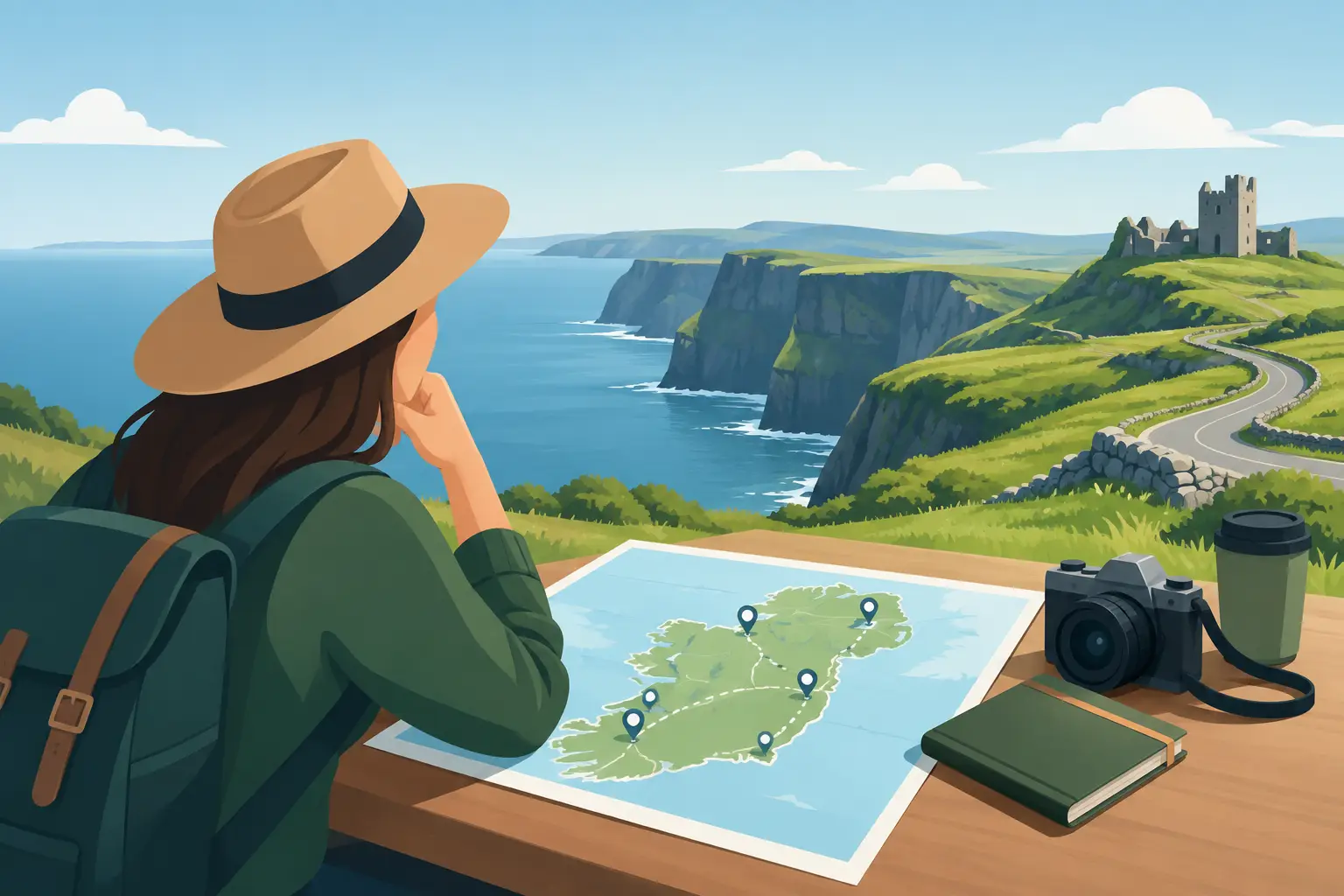
A good Irish road trip should not feel like a race between pin drops. The pleasure is often in what happens between the headline attractions: a quiet beach spotted from the road, a village pub serving lunch later than expected, or a view that deserves another ten minutes. To create a flexible Ireland itinerary, begin with a clear route and leave enough space to follow the country’s invitations.
Ireland looks compact on a map, but narrow roads, changing weather, photo stops and winding coastal stretches can make a short drive a memorable half-day. A flexible plan gives you the confidence of knowing where you are heading without forcing every hour of the holiday into place.
Start with regions, not a long wish list
Trying to see all of Ireland in one week can turn a self-drive holiday into a series of motorway journeys. Instead, choose one or two connected regions and allow them time. The Wild Atlantic Way rewards slower days along the west coast, while the Sunny Southeast is ideal for combining historic towns, beaches and gardens. In Northern Ireland, the North Antrim Coastal Drive offers dramatic scenery, the Giant’s Causeway and plenty of worthwhile stops beyond the busiest viewpoints.
For a week-long trip, it is usually sensible to focus on Dublin and one touring region, or on a loop through the south-west. With 10 to 14 days, you can combine several areas more comfortably, perhaps travelling from Dublin towards Kerry, Clare and Galway, or adding Northern Ireland to a longer island-wide journey.
Think of each region as a base for discovery rather than a box to tick. Staying two or three nights in the same town or village means you can change the next day’s plan if rain rolls in, a favourite stop takes longer, or you simply decide to enjoy a relaxed evening where you are.
Build a route around realistic driving days
Google Maps may tell you a coastal section takes 90 minutes. In Ireland, that estimate rarely includes a coffee in a harbour village, meeting sheep on a country lane, parking near a popular attraction or stopping every time the landscape changes. For an enjoyable touring day, allow roughly two to four hours of actual driving, depending on the roads and how many places you want to visit.
Keep your longest drives for the day you move accommodation. On days when you are staying in the same place, choose a smaller loop with a handful of possible stops. This simple distinction makes your itinerary much easier to adapt.
It also helps to give every day a main experience. That might be the Ring of Kerry, a walk at the Giant’s Causeway, a historic estate in Wexford or a drive through Connemara. Everything else should be optional. If the weather is glorious, you can add a beach, viewpoint or village walk. If visibility is poor or the family needs a quieter day, you have not lost the purpose of the trip.
Allow for Irish roads, weather and daylight
Visitors accustomed to broad main roads can be surprised by Ireland’s smaller routes. Some are wonderfully scenic but narrow, bendy and slow-going. Take care on rural roads, watch for cyclists and livestock, and avoid treating a sat-nav arrival time as a fixed appointment.
Weather should shape your order of stops, especially on the coast. A bright morning may be the right moment for clifftop views, while a rainy afternoon suits a museum, distillery, heritage centre or leisurely lunch. In summer, long daylight hours provide useful freedom. In winter, plan shorter driving days and check seasonal opening times before setting out.
If your route crosses from the Republic of Ireland into Northern Ireland, check that your hire car agreement permits cross-border travel and understand any insurance requirements. The change from kilometres to miles is another small but important detail: road signs and speed limits change after crossing the border.
Choose anchors, then add options
The easiest way to organise a flexible Irish holiday is to give each day three layers: one non-negotiable anchor, two or three strong options, and several easy extras nearby. Your anchor could be a timed attraction booking, a ferry crossing or a well-known scenic drive. The options are places you would genuinely like to see, but can skip without disappointment.
For example, a day on the Ring of Kerry might centre on completing the route and reaching your evening accommodation. Depending on time and weather, you could include a coastal viewpoint, a heritage site and a short walk. A beach, craft shop or local café then becomes a welcome extra rather than another obligation.
This approach is particularly useful for families. Young children may need a beach or playground more than another castle, while older children may enjoy choosing one stop themselves. Couples may prefer a late start, a longer coastal walk or an unplanned lunch in a small town. Flexibility works when the day already has a sensible shape.
Keep famous sights in perspective
Ireland’s best-known attractions deserve their reputation, but they are rarely the whole story. The Giant’s Causeway is extraordinary, yet the surrounding Causeway Coast has castles, harbours, cliff walks and quiet viewpoints that can make the day feel more personal. The same is true of the Wild Atlantic Way, where a famous beach or peninsula can be paired with a local village, a traditional music session or a less-busy stretch of road.
Plan popular places early in the day where possible, particularly during school holidays. You will often find easier parking, more breathing room and a calmer experience. Then keep the afternoon open for discoveries that do not require a booking.
There is a trade-off here. Leaving everything unbooked can create uncertainty during peak season, while pre-booking every attraction removes the freedom that makes a road trip special. Reserve the experiences that matter most, especially accommodation and activities with limited capacity, then let the rest of the route remain adjustable.
Let local knowledge do the research for you
Independent touring does not mean you must spend every evening researching tomorrow’s roads, stories and opening times. A professionally curated self-drive tour can provide the structure while leaving you fully in control of your pace.
MyDriveTour turns the knowledge of qualified Irish tourist guides and chauffeurs into an on-demand companion for your journey. You can follow a recommended route, select the stops that interest you, use turn-by-turn navigation through your preferred mapping app, and hear automatic audio commentary as you reach key locations. It is a practical way to understand what you are seeing without joining a coach tour or keeping your eyes on a guidebook.
The real value is not just convenience. A guide-led route can point you towards lesser-known viewpoints, local stories and places that are easy to drive past without realising their significance. That leaves more time for the spontaneous parts of the day.
Make room for the moments you cannot plan
A flexible itinerary needs a few practical safeguards. Keep accommodation addresses, attraction confirmation details and offline maps available on your phone. Carry water and snacks for longer scenic stretches, and do not rely on every rural stop being open late. If you have a restaurant in mind for dinner, booking ahead can be wise in popular towns, but leave enough time to arrive without rushing.
Most of all, resist the temptation to add one more county simply because it appears close on the map. Ireland is best experienced through its details: the change in landscape after a mountain pass, the welcome in a village shop, the story behind a ruined abbey, and the view that makes you pull over safely just to take it in.
Plan the road, choose the experiences that matter, and leave a little daylight for the unexpected. That is where an Ireland itinerary becomes your own holiday rather than somebody else’s timetable.
