
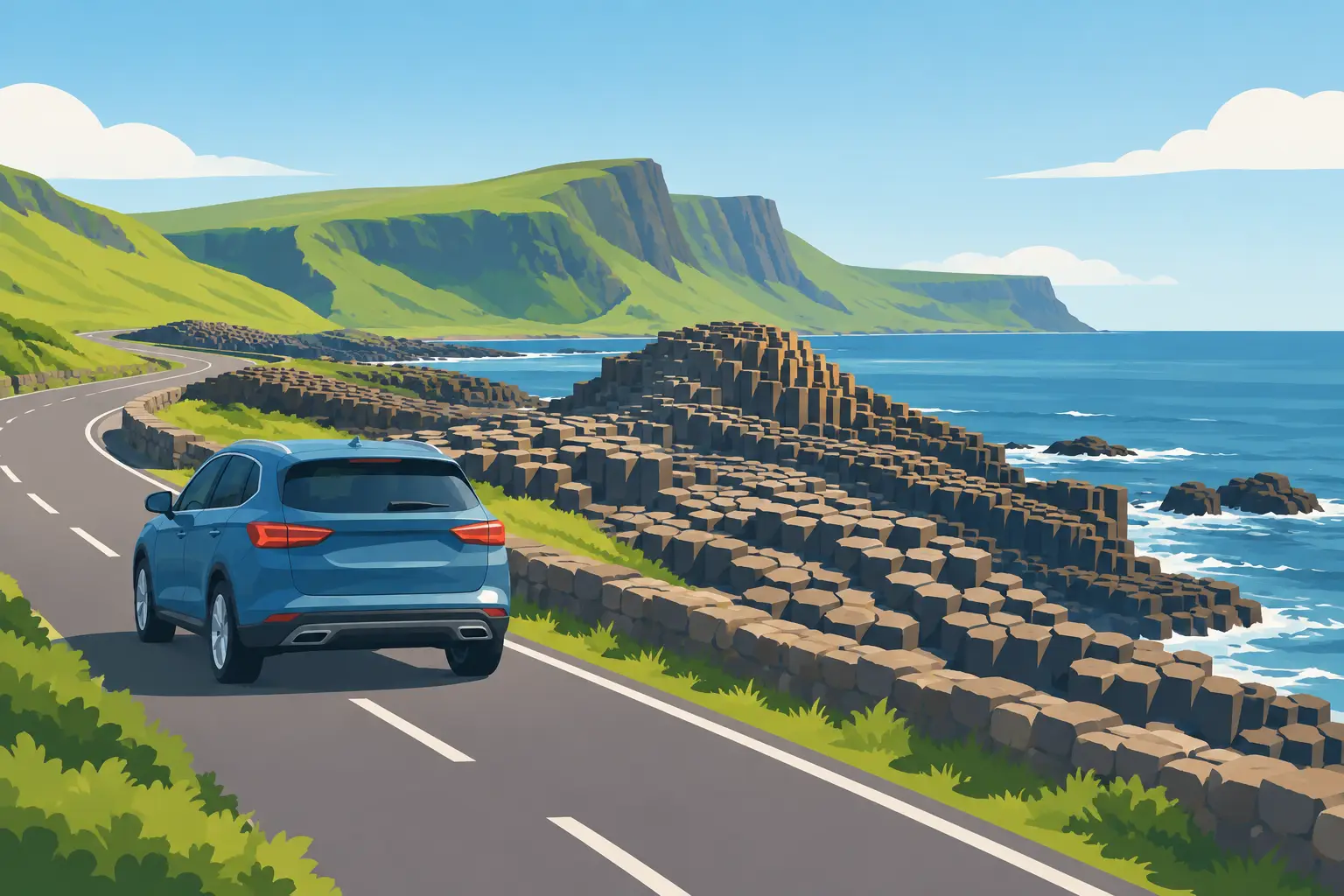
The basalt columns at the Giant’s Causeway are remarkable, but they are only one part of a coast built for a memorable road trip. A Giant’s Causeway self drive tour gives you the freedom to pause at clifftop viewpoints, follow a beach path, linger over lunch in a harbour village and take the photographs a coach timetable cannot wait for. With the right route and a little local context, the journey to the Causeway becomes every bit as rewarding as the destination.
Why drive the North Antrim coast yourself?
The North Antrim coast is not a route to rush. The roads turn through glens, rise above the sea and connect famous film locations with small villages that would be easy to miss on a fixed day tour. Driving yourself means you can begin where it suits your holiday, whether that is Belfast, Derry~Londonderry, Portrush or a cottage along the coast.
It also gives families and independent travellers a better rhythm. Stop when children need a break, spend longer at a place that catches your interest, or skip an attraction that does not suit the weather. A self-drive day works especially well if you want the reassurance of a planned itinerary without being asked to keep pace with a group.
The trade-off is that you are responsible for navigation, parking and deciding what deserves your time. This is where a guide-led driving tour on your phone can make a real difference. You retain the freedom of your own car while receiving the stories, directions and local recommendations that bring the route together.
Building your Giant’s Causeway self drive tour
Most visitors need a full day for the coastal route, particularly if they are starting in Belfast. It is possible to drive directly to the Causeway in around 90 minutes to two hours, depending on traffic and your starting point. But if you have chosen to self-drive, it is worth allowing time for the coastline rather than treating it as a motorway transfer.
A sensible approach is to choose four or five meaningful stops alongside the Causeway itself. The exact order depends on where you are staying and the season. In summer, an earlier start helps at popular car parks; in shorter winter days, select fewer stops and leave generous time for the final walk at the Causeway.
Start with the coast, not just the sat-nav
From Belfast, many travellers head north through Carrickfergus before joining the Antrim Coast Road. This dramatic road wraps around the shoreline, with the sea on one side and steep green hills on the other. It is scenic rather than fast, so build that into your plans.
The route is generally straightforward, but some stretches are narrow and winding. Drive to the conditions, expect cyclists and walkers, and use designated parking areas rather than stopping on bends for a photograph. In Northern Ireland, distances and speed limits are shown in miles, and motorists drive on the left.
If you are based around Portrush, Portstewart or Bushmills, you can approach the Causeway from the west. This is a very practical option for an early or late visit, and leaves more time to explore Dunluce Castle and the villages nearby.
Choose stops that tell the coast’s story
The best day is not necessarily the one with the longest checklist. These are some of the most worthwhile places to weave into your route:
- Carrick-a-Rede Rope Bridge offers a thrilling clifftop walk and wide views towards Rathlin Island and Scotland. Access arrangements can vary, so allow time and be prepared for exposed conditions.
- Ballintoy Harbour is small, atmospheric and wonderfully placed beneath rugged headlands. It is a good stop for a short walk and has become familiar to many television viewers, though its appeal goes far beyond a filming location.
- The Dark Hedges provides the famous avenue of intertwined beech trees. It is best treated as a brief detour, not the centrepiece of your day, and access rules can change to protect the road and visitors.
- Dunluce Castle sits on a dramatic basalt outcrop above the Atlantic. Even from the viewpoint, its position is striking; allow more time if you want to go inside and explore the ruins.
- Bushmills is a convenient place for refreshments and a useful base for reaching the Causeway. It can be particularly welcome after a breezy morning by the cliffs.
You do not need to do all of them. For example, Carrick-a-Rede and the Causeway both involve walking, so families with younger children may prefer Ballintoy Harbour and Dunluce Castle instead. In wet weather, a castle visit, a relaxed lunch and the visitor facilities at the Causeway may be a more comfortable combination than several exposed coastal paths.
Make time for the Causeway itself
The Giant’s Causeway is a UNESCO World Heritage Site, formed by ancient volcanic activity and wrapped in the enduring story of Finn McCool. The science is impressive, but the legend gives the stones their character. As you walk down towards the columns, look beyond the best-known hexagons: the coastal setting, the waves and the surrounding cliff formations are part of the experience.
Parking and visitor arrangements can be busy, particularly in school holidays and on clear summer afternoons. Check current opening and access information before setting off, and arrive earlier in the day where possible. From the visitor area, the main route to the stones is downhill, which is worth remembering when planning the walk back up.
Wear shoes with grip. The stones can be slippery after rain or sea spray, and the weather changes quickly on this stretch of coast. A waterproof layer is more useful than an umbrella in a strong Atlantic breeze. Bring water and a snack too, especially if you are combining the Causeway with longer cliff walks.
There is no prize for reaching every viewpoint. Take time to sit, listen to the sea and see how the columns change with the light. Morning can feel quieter; late afternoon often gives the rocks a warmer colour. Either can be better than arriving at the busiest point of the day.
Let your phone do the guiding, not the distracting
A good self-drive tour should not turn your holiday into a screen-based exercise. The most helpful technology works in the background: it sends the route to your preferred mapping app, prompts you towards the next stop and plays commentary as you arrive at places with a story to tell.
That is the appeal of MyDriveTour. Its North Antrim driving experience is shaped by the knowledge of qualified Irish tourist guides and chauffeurs, then designed for the independence of your own car. Automatic audio commentary can explain why a harbour mattered, where a local legend began or what you are seeing beyond the windscreen, while you keep your attention on the road and the view.
You can start from a point that suits you, select the stops that appeal and move at your own pace. It is a practical middle ground between piecing together dozens of search results and committing to a coach schedule. Download the tour before you leave reliable Wi-Fi, make sure your phone is charged and bring a car charger if you have one.
Practical details for a smoother day
Fuel up before you enter the quieter coastal stretches, and do not rely on every village having the same facilities or opening hours year-round. Mobile signal can vary in rural locations, another good reason to have maps and tour content ready in advance.
If your route crosses from the Republic of Ireland into Northern Ireland, remember that Northern Ireland uses pounds sterling and miles. Drivers in a hire car should also check their rental agreement for cross-border conditions before travelling. These are simple details, but knowing them in advance keeps the day relaxed.
Finally, leave room for the unexpected. A patch of sunlight over the sea, a roadside craft shop, a quiet beach or a recommendation from a café owner can become the moment you remember most. Set a clear route, give yourself time at the Giant’s Causeway, then let the North Antrim coast reward your curiosity.
