
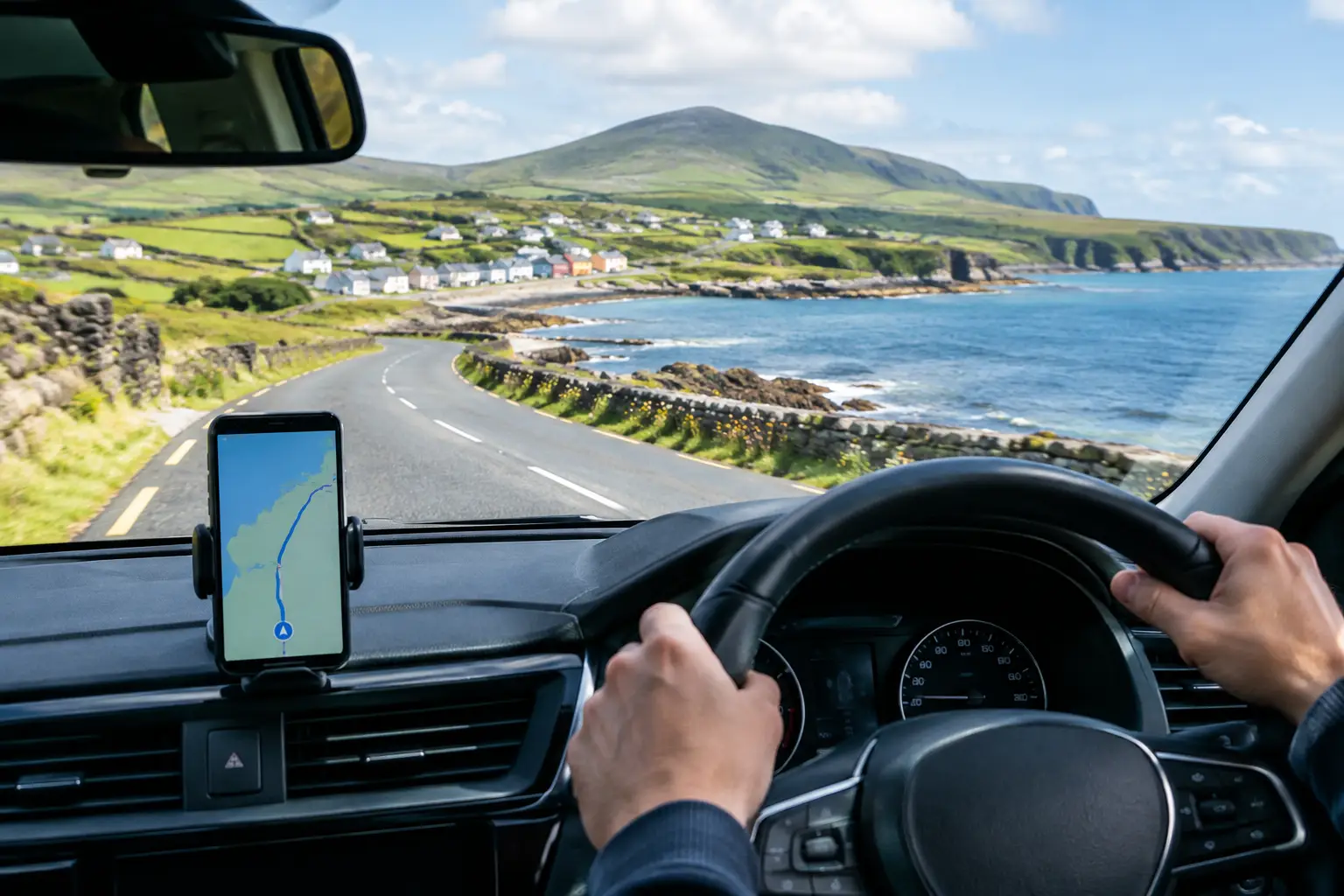
The first roundabout, the first narrow lane and the first view of the Atlantic often arrive sooner than visitors expect. So, can tourists drive in Ireland? Yes – most visitors can, provided they hold a valid full driving licence, meet their car hire company’s conditions and feel comfortable driving on the left. With a little preparation, a self-drive holiday is one of the most rewarding ways to see Ireland beyond the coach-tour stops.
Ireland is made for independent exploration. A car gives you the freedom to pause at a stone fort, take a detour to a beach, linger in a small town for lunch or change plans when the weather clears over the mountains. The key is allowing enough time and understanding a few local rules before collecting the keys.
Can Tourists Drive in Ireland With Their Home Licence?
Visitors with a full, valid driving licence can generally drive in the Republic of Ireland while visiting temporarily. Licences issued in the EU and EEA are straightforward to use. If your licence was issued outside those areas, you can usually drive as a visitor too, but check the requirements of your chosen car hire company well before travel.
If your licence is not in English, an International Driving Permit can be useful as an official translation and may be requested by a rental provider. It does not replace your original licence, so bring both documents. Even when an International Driving Permit is not legally required, having one can remove uncertainty at the hire desk.
Car hire firms set their own policies on minimum age, maximum age, how long you must have held your licence and accepted forms of identification. Many also require a credit card in the main driver’s name for the security deposit. Do not assume that a debit card, digital driving licence or photocopy will be accepted.
If more than one person hopes to drive, add every driver to the booking before leaving the depot. Letting an uninsured friend or family member take the wheel can create a serious problem if there is an incident, however short the journey may seem.
The Biggest Adjustment: Drive on the Left
In both the Republic of Ireland and Northern Ireland, traffic keeps left. The steering wheel is on the right-hand side of the vehicle, and manual cars are common. For visitors used to driving on the right, the adjustment is manageable, but it deserves your full attention during the first day.
The moments that catch people out are usually quiet ones: pulling out of a petrol station, turning at an empty junction or leaving a car park. Say “keep left” to yourself if it helps, and choose an easy first route rather than beginning with a city-centre drive or a long mountain pass.
Roundabouts are the other major change. Approach from the left, give way to traffic already on the roundabout coming from your right, and travel clockwise. Road markings and signs make the intended lane clear on larger roundabouts, but take your time and do not worry about taking an extra circuit if you miss an exit. A safe extra minute is better than a rushed manoeuvre.
An automatic car can make the first few days simpler, especially if you are not accustomed to changing gear with your left hand. They are usually less plentiful than manual vehicles, so reserve early if an automatic is essential.
Know Which Ireland You Are Driving In
A driving holiday can cross the border between the Republic of Ireland and Northern Ireland without an obvious checkpoint, particularly on routes around Donegal, Derry/Londonderry, Fermanagh and the Causeway Coast. The driving side remains the same, but measurements change.
In the Republic of Ireland, speed limits and distances are shown in kilometres. In Northern Ireland, they are shown in miles, as elsewhere in the UK. Your hire car’s speedometer may display both, but check it before setting off. A number that feels familiar can mean something quite different across the border.
Tell the car hire company if you plan to take the vehicle into Northern Ireland. Cross-border driving is often permitted, but the company may need to record it or provide the right documentation and insurance cover. It is much easier to arrange this in advance than to alter plans midway through the holiday.
Insurance, Deposits and the Small Print
Car hire insurance can feel less exciting than choosing a coastal route, but it is worth reading carefully. Your booking commonly includes basic cover, with an excess – the amount you could be responsible for if the vehicle is damaged or stolen. Optional excess reduction products may lower that liability, but terms vary widely.
Check what is covered for tyres, wheels, windscreens, roof damage and the vehicle underside. These are particularly relevant on rural roads, where a hidden pothole, loose stone or high grass verge can do damage. Take clear photographs or video of the car at collection, including every existing mark, and make sure any damage is recorded before you leave.
Ask about the fuel policy, toll arrangements, additional-driver fees and charges for returning the car late. If a staff member explains something quickly, ask them to repeat it. A few practical questions at the desk can prevent an unwelcome surprise after the trip.
Rural Roads Reward Patience
Ireland’s scenic routes are not always fast routes. The Ring of Kerry, Wild Atlantic Way, Causeway Coast and roads through Connemara can look short on a map, yet take longer than expected because of bends, viewpoints, villages, farm traffic and weather.
On narrow local roads, slow down early and expect oncoming vehicles. You may need to pull into a passing place or a wider section of road. If another driver has already stopped to let you through, acknowledge them with a wave and pass carefully. Avoid mounting a soft verge simply to squeeze by; it may conceal a ditch or unstable ground.
Sheep, cattle, cyclists, walkers and horses can all appear on country roads. Around a blind bend, drive at a speed that lets you stop safely within the distance you can see. This is especially important after rain, at dusk and on exposed coastal stretches where wind can affect the car.
Do not stop in the carriageway to photograph a view. Find a marked lay-by, car park or safe place where the vehicle is fully off the road. The best viewpoints are more enjoyable when you are not worrying about traffic behind you.
Signs, Speeds and Parking
Follow posted speed limits rather than relying on assumptions. Limits can change quickly when entering a village, approaching a school or moving between road types. In the Republic, signs use kilometres per hour; in Northern Ireland, miles per hour. Speed cameras, mobile enforcement and bus-lane restrictions are used in urban areas, so pay close attention near Dublin, Cork, Galway, Belfast and other busy centres.
Ireland’s road signs are generally easy to follow once you recognise the system. In the Republic, directional signs commonly distinguish motorways, national roads and local routes by colour. In Gaeltacht areas, place names may appear in Irish only, so it helps to have your destination saved in your navigation app before setting off.
Parking rules are strictly enforced in towns and cities. Look for signs explaining payment, maximum stay and resident-only restrictions. Never assume that a free-looking kerb is suitable for parking. In popular places such as Kinsale, Kilkenny, Dingle or Westport, arriving earlier in the day can make parking far less stressful.
Tolls apply on some major roads in the Republic of Ireland. The M50 around Dublin uses barrier-free electronic tolling, so ask the rental company how payment is handled for its vehicles. Do not leave this until after you have driven the route.
Make the Drive Part of the Holiday
A self-drive tour works best when the route leaves room for discovery. Rather than trying to cover an entire coast in one day, choose a manageable stretch and build in time for short walks, cafés, ruins and viewpoints. A two-hour map estimate can easily become half a day once Ireland starts offering reasons to stop.
This is where a GPS-guided touring app can be especially useful. MyDriveTour offers affordable self-drive routes with suggested sightseeing stops, navigation support and concise audio commentary about places along the way. It is designed as a practical companion for travellers who want direction and local context while keeping control of their own timetable – not as a replacement for a live guide. For a trip that takes in several regions, the All Tours Bundle brings 13 driving and walking experiences together for €45.
Before setting off each morning, download maps or confirm your mobile-data plan, charge your phone and keep a charging cable in the car. It is also sensible to keep water, layers and comfortable footwear nearby. A roadside abbey or cliff path has a habit of becoming the day’s unexpected highlight.
A Confident Start Behind the Wheel
Collect your car in daylight if possible, especially after a long flight. Take ten minutes in the car park to adjust mirrors, find the lights and wipers, understand the fuel type and practise reversing. Programme your first destination before moving off, then give yourself a gentle first drive.
If something feels beyond your comfort level – a stormy coastal road, a busy city centre or a particularly tight lane – choose the safer alternative. Ireland’s memorable places are not limited to the most challenging roads. With sensible preparation and a relaxed pace, the drive becomes part of the story: a castle sign spotted at the last minute, a harbour reached before sunset, or a quiet road leading somewhere you had not planned to find.
