
The first few minutes behind the wheel in Ireland can feel surprisingly busy: you are driving on the left, reading unfamiliar road signs and perhaps meeting your first roundabout before you have left the airport. This Ireland driving rules guide focuses on the practical habits that make a self-drive holiday safer, calmer and far more enjoyable.
Ireland rewards drivers who slow down and stay alert. The roads can change quickly from modern motorway to a narrow lane edged by stone walls, with a sheep around the next bend or a tractor just ahead. A little preparation gives you the confidence to enjoy the scenery without treating every junction as a test.
Start with the left-hand driving basics
In the Republic of Ireland and Northern Ireland, traffic keeps left. That means you drive in the left lane, overtake on the right and turn left across the nearest side of a junction. It sounds simple, but it is worth consciously repeating to yourself when pulling out of a car park, petrol station or scenic lay-by. Those are the moments when visitors are most likely to drift towards the wrong side of the road.
Your steering wheel will be on the right, and the gear lever is normally operated with your left hand. If you have not driven a manual car this way before, an automatic rental can remove one task from the first day of your holiday. There is no shame in choosing the easier option, particularly if your itinerary begins in a city or includes long days on winding coastal roads.
Seat belts are required for drivers and passengers. Children must use a suitable child restraint, so arrange this with your rental provider in advance if needed. Do not hold or use a mobile phone while driving. Set your navigation, music and route before moving off, then pull over safely if anything needs attention.
Ireland driving rules guide: understand signs and speed limits
The most useful distinction for cross-border travellers is this: the Republic of Ireland uses kilometres and kilometres per hour, while Northern Ireland uses miles and miles per hour. Speed limit signs make the unit clear, but the change can catch people out when travelling between Donegal and Northern Ireland, or along an itinerary that includes Belfast and the Causeway Coast.
In the Republic, speed limits are generally shown as a number inside a red circle with “km/h” displayed on the sign. In Northern Ireland, the signs use mph. Always follow the posted limit, rather than relying on a sat-nav display or a figure remembered from another road. Temporary limits near roadworks, schools and villages matter just as much as permanent ones.
The legal maximum is not a target speed. On a narrow rural road, the safe speed may be much lower than the sign allows because of blind bends, rain, loose gravel, walkers or oncoming vehicles. Give yourself permission to drive slowly. Local drivers may know every bend, but you do not need to match their pace. If traffic builds behind you, wait for a safe, appropriate place to let it pass rather than stopping suddenly or edging into an unsafe verge.
Road signs in the Republic often use Irish and English place names, while Northern Ireland uses English. You may also see directional signs that distinguish motorways, national roads, regional roads and local routes. Follow the signs and your chosen route, but keep an eye on road conditions rather than assuming the shortest line on a map is the quickest or easiest drive.
Take roundabouts one decision at a time
Roundabouts are common throughout Ireland and are usually efficient once you know the rhythm. Approach slowly, read the lane markings and signs early, and give way to traffic already on the roundabout coming from your right. Enter only when there is a safe gap.
For a left turn or first exit, keep left and signal left as you approach. For a straight-ahead exit, the correct lane depends on the road markings, so look well before the roundabout and signal left after passing the exit before yours. For a right turn or later exit, you will often approach in the right-hand lane, then move towards the left as you prepare to leave. Large multi-lane roundabouts can vary, which is why lane arrows and local signs should always take priority over a rule of thumb.
Do not worry if you miss an exit. Continue around when safe and try again. That is considerably better than changing lanes abruptly or attempting to reverse.
Rural roads require more time than the map suggests
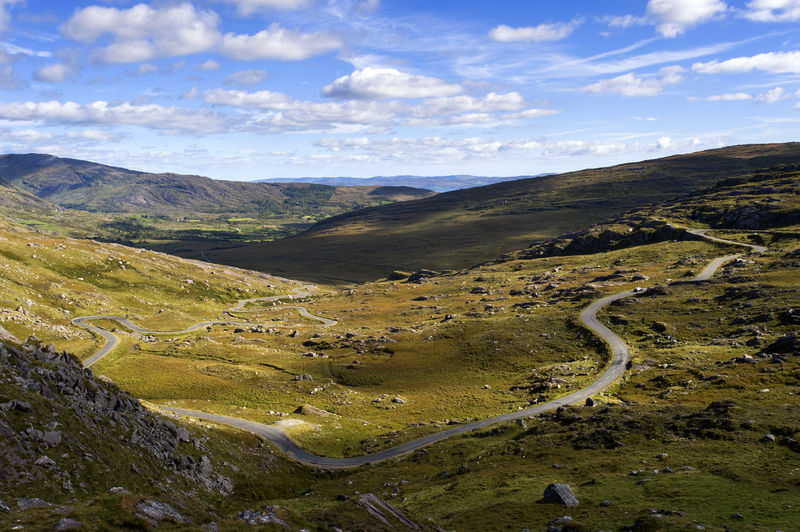
Some of Ireland’s most memorable drives run through places where roads are narrow, winding and beautifully exposed to the weather. On parts of the Wild Atlantic Way, Ring of Kerry, Causeway Coast and Ireland’s southeast, a short distance can take longer than expected. Build that reality into your day.
Single-track roads require patience and courtesy. Use passing places only when they are clearly intended for passing, and be prepared to reverse carefully to a wider point if necessary. Avoid mounting a soft verge or pulling into a gateway unless you have clear permission and enough room. Stone walls, drainage ditches and hidden edges are less forgiving than they look.
Expect farm vehicles, cyclists, horses, walkers and animals on country roads. Reduce speed before blind crests and bends, keep both hands ready on the wheel and avoid cutting corners. In wet weather, allow more braking distance. After heavy rain, standing water and surface debris can appear quickly, especially on smaller roads.
A scenic route should not become a race against daylight. If you want time for a beach walk, a ruined abbey, a village café or a clifftop viewpoint, plan fewer kilometres than you might on a motorway-based journey. The unplanned stops are often the ones you remember.
Parking, stopping and overtaking safely
Parking restrictions are usually marked by road signs, kerb markings or yellow lines. Rules differ between towns and cities, and some parking areas require payment or have time limits. Check the sign at the exact place where you park rather than assuming the restriction is the same along the whole street.
Never stop in a way that blocks a narrow road, farm entrance, bus stop, junction, cycle lane or emergency access. Scenic pull-ins and signed car parks are the best choice for photographs. A quick roadside stop can create a hazard if your vehicle is partly in the traffic lane or hidden after a bend.
Overtaking needs a clear, long view ahead and enough room to complete the manoeuvre without forcing anyone else to brake. On rural roads, that opportunity is often rarer than it first appears. Do not overtake near junctions, bends, brows of hills, pedestrian crossings or solid centre lines. If you are uncertain, stay back. You will lose very little time and avoid the holiday’s biggest risk.
Motorways, tolls and city driving
Motorways are generally the simplest roads to drive, but they have their own rules. Keep left unless overtaking, leave generous space from the vehicle ahead and use slip roads to join and leave safely. Do not stop, reverse or turn around on a motorway except in an emergency. Watch for lane signs well ahead of larger junctions, particularly around Dublin.
Some routes have tolls. Your rental company can explain how toll payments are handled for the vehicle you collect, especially where electronic tolling applies. Ask before leaving the depot so that you understand any charges, payment process and administrative fees.
City centres bring buses, delivery vehicles, pedestrians, cyclists and complex lane markings into a smaller space. Bus lanes may have restricted operating hours, shown on signs beside the lane. If city driving feels stressful, consider collecting your car after your time in the city or returning it before your final urban stay. It depends on your itinerary, but avoiding a car in central Dublin or Belfast can make a holiday feel much simpler.
Alcohol, fatigue and unexpected delays
Ireland takes drink-driving seriously. The clearest holiday rule is to avoid alcohol entirely if you may drive, including the following morning if you are unsure. Do not rely on feeling fine or on informal estimates.
Fatigue deserves the same caution. Jet lag, poor weather and long sightseeing days can reduce concentration. Share the driving where possible, take regular breaks and do not try to squeeze a major scenic route into the final hours before dinner. If conditions worsen, adjust the plan.
For emergencies, 112 and 999 are the emergency numbers across Ireland. Keep your rental company’s roadside assistance details accessible as well. Before setting off, check fuel, tyre condition, lights and the weather forecast, especially when heading into remote coastal or mountain areas.
A GPS-guided route can reduce the pressure of watching every turn. MyDriveTour provides suggested stops, navigation and concise audio commentary for independent travellers, allowing you to focus on the road while deciding which sights are worth your time.
The best Irish driving days leave room for a missed turn, a sudden shower and a sign pointing towards somewhere you had not planned to see. Drive thoughtfully, make the safe choice when the road asks for it, and let the journey set its own pace.
