
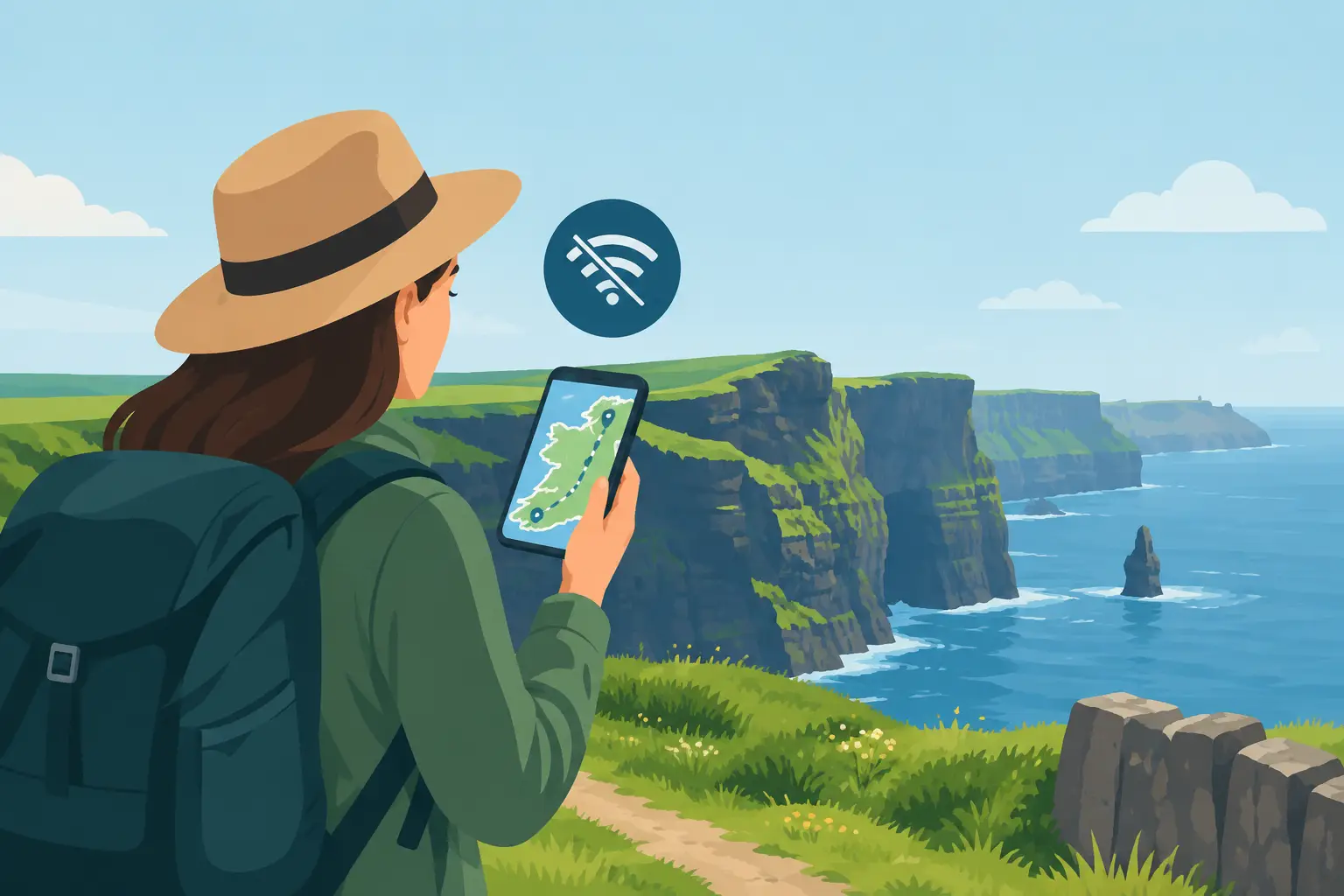
The best Irish moments often happen where the signal fades. You might be rounding a headland on the Wild Atlantic Way, following a quiet lane towards a stone fort, or pulling into a small harbour with no reason to hurry. To tour Ireland offline is not to travel without help. It is to make sure your route, stories and essential information are ready before the countryside asks your phone to work a little harder.
For independent travellers, that preparation creates real freedom. You can follow the coast without worrying about a dropped data connection, stop when a view catches your eye, and hear the local story at the place where it matters most. A well-planned offline touring setup keeps the practical side of a self-drive holiday simple, leaving more room for the roads, villages and landscapes you came to see.
Why touring offline makes sense in Ireland
Ireland has excellent road-trip territory, but it is not a place to assume a constant mobile connection. Coverage can vary on rural roads, in mountain valleys and along more remote stretches of coast. Even where a signal is available, using mobile data abroad can be expensive if your plan has limited roaming.
Offline preparation is especially useful on routes where the journey is part of the experience. The Ring of Kerry, North Antrim Coastal Drive, the Sunny Southeast and long sections of the Wild Atlantic Way reward a relaxed pace. They also include detours, viewpoints and local places that may not appear in a quick internet search.
There is a difference between being disconnected and being unprepared. Downloaded mapping, saved tour content and a charged phone mean you can travel confidently while remaining present in the moment. You are not repeatedly stopping to search for the next turn or reading a guidebook while trying to enjoy the view.
What you need to tour Ireland offline
An offline trip works best when you prepare the essentials before leaving accommodation with reliable Wi-Fi. Start with your route. Download the map areas you expect to use, then check that the route displays properly when your phone is in aeroplane mode. It is worth doing this before you reach a remote peninsula or begin a full day of driving.
You also need a reliable way to keep your phone powered. Navigation, location services and audio commentary use battery, particularly during a long day in the car. A car charger is useful, and a compact power bank gives reassurance during walking sections or when several people are using one vehicle.
Finally, keep the basics accessible outside your phone. Your accommodation name and postcode, booking references, emergency contacts and the day’s broad plan can be saved in a note or written down. This is not old-fashioned caution. It is sensible road-trip preparation, particularly if you are unfamiliar with Irish place names and rural roads.
Download maps before setting out
Offline maps provide the safety net. Download maps for the regions you will drive through rather than relying only on a route loaded at the start of the day. If your holiday includes Dublin, Kerry, Clare, Galway, Donegal and Northern Ireland, save each relevant area in advance.
Check your mapping app settings too. Some apps require you to select downloaded areas manually, while others will use them automatically if data is unavailable. Keep location services on, as GPS can still identify where you are without a mobile signal. What may be missing is live traffic information, so allow a little extra time and follow local road signs where necessary.
Do not treat your phone as an excuse to ignore the road. Ireland’s scenic routes can involve narrow lanes, changing speed limits, sheep on the roadway and frequent stopping points. Let a passenger manage the device where possible, or pull in safely before changing your plan.
Save a guide, not just a pin
A map can tell you where a viewpoint is. It cannot always tell you why a ruined abbey matters, which quiet beach is worth the small detour, or how a local landscape shaped the community around it. That is where a professionally curated audio tour adds a more meaningful layer to offline touring.
MyDriveTour is designed to put the knowledge of qualified Irish tourist guides and chauffeurs in your pocket. Once tour content is ready on your device, it can guide you through a route at your own pace, with automatic audio commentary triggered at relevant points of interest. You retain the freedom to begin where it suits you, skip a stop that does not appeal, or spend longer at the places your family enjoys most.
This matters because Ireland is best experienced as more than a checklist of headline attractions. The famous sights are deservedly popular, but a great self-drive day often includes the small details between them: a local tale, an unexpected viewpoint, a village with a worthwhile café, or a coastal road that makes the direct route seem unimportant.
A practical routine for offline driving days
Before you leave each morning, take five minutes to confirm the day’s plan. Open the tour while connected to Wi-Fi, ensure the relevant route is available, and start your preferred mapping app. Look at the overall distance rather than only the driving time. On Irish touring roads, a short distance can take longer than expected when you include photographs, attraction visits and slower local traffic.
Choose a sensible number of stops. It is tempting to fit every attraction into a single day, particularly on a first visit. Yet routes such as the Ring of Kerry or Causeway Coast are far more enjoyable when you leave space for the unplanned moments. A good digital guide gives structure, but it should not turn your holiday into a race against the clock.
Keep audio volume clear but comfortable. Commentary should enhance the journey, not distract the driver. If travelling as a family, agree on a simple rhythm: listen on the approach, stop if the place interests you, then continue when everyone is ready.
At the end of the day, recharge devices and review the next section of your trip while you have Wi-Fi. This is also a good time to save any new places you heard about from locals. The best recommendations in Ireland are often passed across a shop counter, in a pub or by an accommodation host, and they can easily become tomorrow’s favourite stop.
When offline touring has limits
Offline tools are dependable, but they do not replace common sense. Road closures, severe weather, ferry changes and attraction opening hours can alter plans with little notice. Check local conditions before a long drive, especially in winter or when travelling through exposed coastal and upland areas.
It also depends on the type of holiday you want. If your priority is live traffic updates, last-minute restaurant searches and constant social posting, a local data option may still be worthwhile. Offline touring is not about refusing connectivity. It is about making sure poor coverage does not dictate the quality of your day.
For some travellers, a chauffeur-driven trip is the better fit, particularly for a special occasion or a holiday where nobody wants to drive. For most independent visitors, however, prepared maps and guide-led audio offer a comfortable middle ground: the confidence of expert local direction with the freedom to make the journey your own.
Make the road part of the holiday
The strongest reason to tour Ireland offline is not technical. It is experiential. When every essential detail is already in place, you can look up from the screen. You notice the dry-stone walls, the sudden change in light over the Atlantic, the hand-painted sign pointing towards a beach, and the stories that give each stop its character.
Prepare your device, choose a route with room to breathe, and let Ireland reveal itself one turn at a time.
