
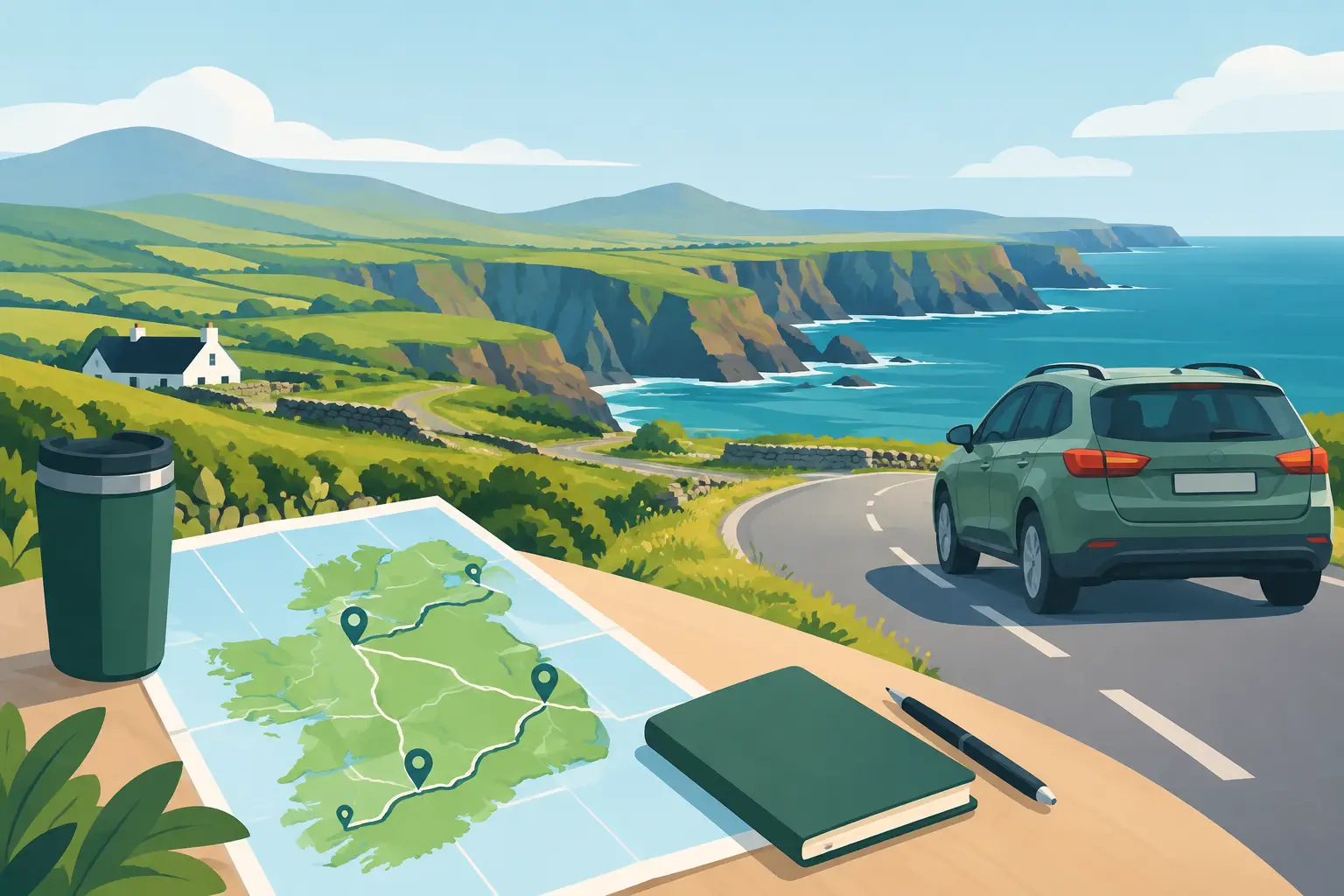
The best Irish road trips rarely follow the quickest line between two famous places. They turn off for a harbour village, pause at a viewpoint when the light changes, or make room for a story that gives an old ruin its meaning. An Ireland itinerary planner should make those moments possible, while still giving you confidence that each day is realistic.
For independent travellers, the challenge is not finding things to see. Ireland and Northern Ireland have no shortage of castles, coastlines, gardens, pubs and walking trails. The challenge is choosing the right stops in the right order, allowing enough time to enjoy them, and knowing what you are looking at when you arrive.
Start your Ireland itinerary planner with regions
Trying to cover the whole island in one short holiday can turn a scenic drive into a succession of motorway services and hurried photographs. Begin by choosing one or two regions that suit the time you have, then build your overnight stays around them.
The Wild Atlantic Way rewards travellers who can linger. A route through Donegal, Sligo, Mayo and Connemara has dramatic headlands, mountain roads and long beaches, but distances take longer than they appear on a map. In the south-west, the Ring of Kerry and neighbouring peninsulas provide a strong mix of coastal scenery, heritage sites and lively towns. The Sunny South East is a good choice for those who enjoy historic houses, gardens, medieval towns and gentler coastal driving.
Northern Ireland offers another excellent road-trip region. The North Antrim Coastal Drive can combine the Giant’s Causeway, cliff-top walks, castles and striking beaches in a manageable stretch of coast. It works particularly well for travellers arriving from Belfast or crossing the border as part of a longer itinerary.
Choose accommodation bases that reduce unnecessary packing and driving. Two or three nights in one area can be more rewarding than changing hotels every evening. A base near Killarney, for example, gives you access to the Ring of Kerry, the Dingle Peninsula and quieter local routes, although each deserves more than a rushed afternoon.
Build days around driving reality
Irish roads are part of the experience, but they are not always fast. A route that looks short online may include narrow rural lanes, bends, tractors, village traffic and frequent reasons to pull over. Plan conservatively, especially if it is your first time driving on the left or collecting a hire car after a flight.
A good touring day has a main destination, a small number of worthwhile stops and time left unplanned. Aim for one major attraction or walk, then allow the scenery to set the pace. You may want to spend an hour at a heritage site, stop for lunch in a market town, and still have enough daylight for a beach or viewpoint near your accommodation.
As a guide, keep full-day driving to a comfortable level rather than treating every kilometre as a target. A coastal route with several viewpoints can easily occupy a whole day, even when the distance is modest. On the other hand, a transfer day along better roads can carry you between regions without needing a packed programme.
Weather also changes the calculation. A rainy morning may be ideal for a museum, distillery tour or historic house, while a clear late afternoon can transform a clifftop walk. Leave space in your plan to switch the order of nearby stops. Flexibility is not a lack of planning – it is what lets a well-planned holiday work in real conditions.
Give famous sights the time they deserve
The biggest sights are popular for a reason, but they are often best balanced with places that sit just beyond the busy car park. The Giant’s Causeway deserves time to walk among the columns and follow the coastal paths, rather than simply taking a quick photograph. The Ring of Kerry is far more enjoyable when you include short detours, viewpoints and villages rather than driving the circuit at speed.
Your itinerary should also account for opening hours, seasonal changes and parking. Some visitor attractions operate reduced hours outside peak season, while rural cafés and smaller sites may not open every day. Check practical details close to departure, but avoid filling every hour with reservations. You are in Ireland to experience the place, not to keep an appointment diary.
Add local context, not just pins on a map
A map can take you to a landmark. It cannot tell you why a tower was built, how a landscape shaped local life, or where the story behind a place begins. Those details are often what turn a stop into a memory.
This matters most when travelling independently. At a castle, stone circle or famine-era site, clear local interpretation gives the landscape depth. On quieter roads, it can point you towards a hidden cove, a small village or a viewpoint that would otherwise pass unnoticed. The best itinerary planners combine navigation with guide-led knowledge, so you do not have to spend each evening researching the next day.
MyDriveTour is designed for exactly this style of holiday. Its self-guided driving and walking tours put professionally curated routes, turn-by-turn directions and location-based audio commentary in your pocket. As you approach a point of interest, the story is ready at the relevant moment, rather than waiting in a guidebook for you to find it.
You remain in control of the day. Start from the point that suits your accommodation, choose the stops that interest you and take longer where the scenery or atmosphere calls for it. This is particularly useful for families, couples and small groups whose pace may differ from a fixed coach itinerary.
Choose the right mix of driving and walking
A road trip needs time out of the car. Build a short walk into most days, even if it is simply a harbour stroll, woodland path or clifftop viewpoint. Ireland’s best scenery often reveals itself just beyond the road, and a gentle walk is a welcome change after a morning of driving.
Be honest about what your group will enjoy. An ambitious hike may be perfect for experienced walkers with suitable footwear and changeable-weather clothing. A family with younger children may get more from a beach, castle grounds and an early dinner. The right itinerary is not the one with the most stops – it is the one that leaves everyone feeling they have properly seen the area.
Keep an alternative in mind for wet or windy days. Towns such as Kilkenny, Waterford, Galway and Belfast offer history, food and indoor attractions when the weather makes exposed coastal plans less appealing. That alternative is not a compromise; it is part of a sensible island itinerary.
Plan the practical details before the road opens up
A few simple preparations make self-drive touring much easier. Download your chosen route information while you have reliable Wi-Fi, make sure your mobile phone is charged, and bring a car charger or power bank. Check that your preferred mapping app is ready before leaving your accommodation, particularly in more remote areas where mobile signal can vary.
If you are travelling between Ireland and Northern Ireland, remember that road signs and speed limits use different units. In the Republic of Ireland, speeds are shown in kilometres per hour; in Northern Ireland, they are shown in miles per hour. This is easy to manage once you know, but it is worth discussing with every driver in your party.
Do not underestimate arrival time, either. Reaching your hotel before dark can make the first evening in a new area more relaxed, especially on rural roads. Save the long scenic loop for the following morning, when you can enjoy it rather than racing daylight.
A thoughtful Ireland itinerary planner gives you a route, but it should also leave room for the unexpected: a traditional music session heard from an open pub door, a roadside honesty box, a view that asks you to stop one more time. Those are the moments a well-paced self-drive holiday is made for.
