
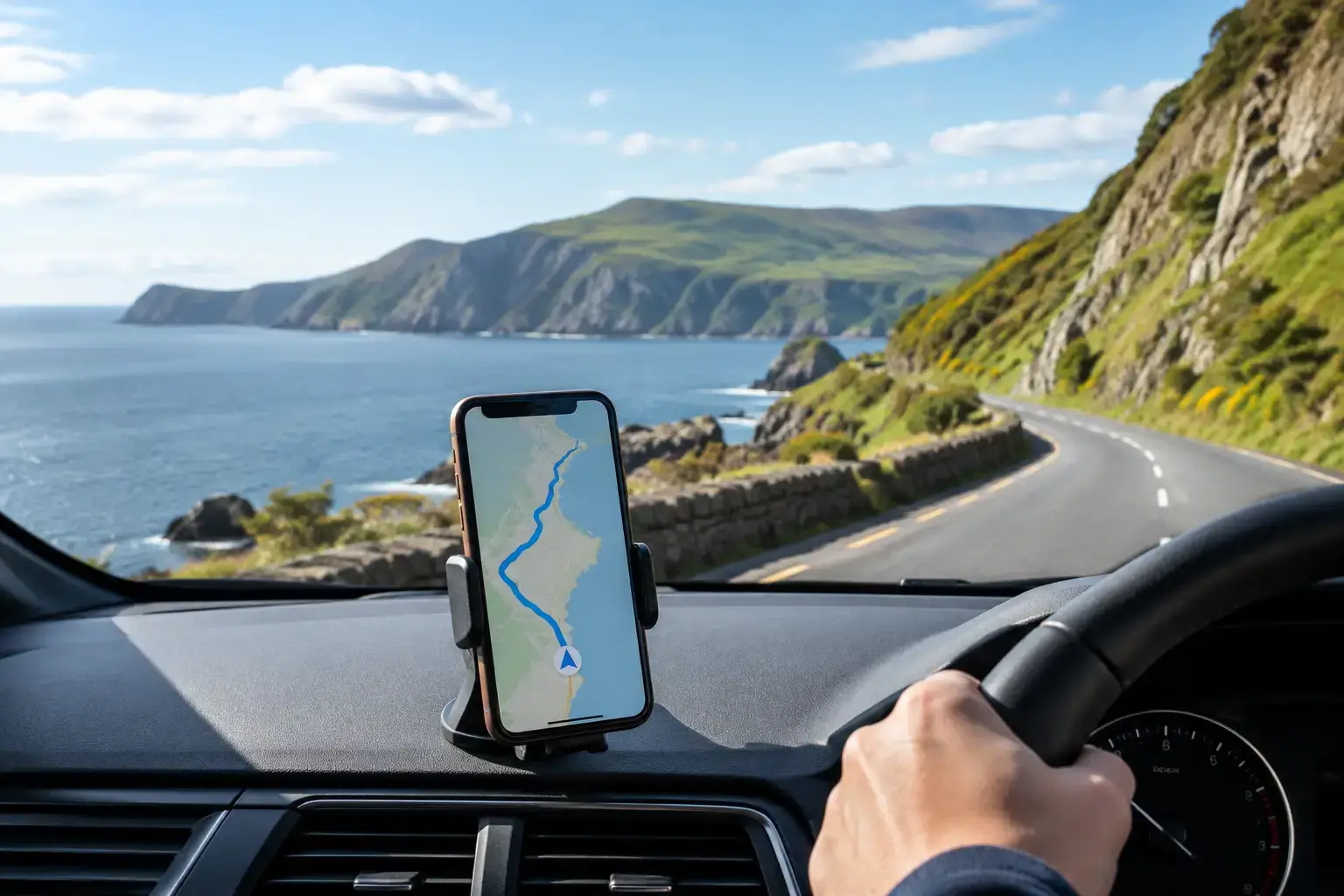
A coastal viewpoint appears beyond the next bend, but there is no need to rush past it because a coach timetable says so. That freedom is the central appeal of a self-drive holiday – and understanding how GPS tours work in Ireland helps you use it well. Rather than following a group or trying to research every landmark while driving, you use a mobile app to follow a planned route, see worthwhile stops and hear brief audio introductions at selected places.
A GPS tour is not a live guide in your car, and it is not intended to replace the depth of a private guide. It is a practical sightseeing companion: one that provides direction and context while leaving you in charge of the day. You decide whether a beach deserves ten minutes or an afternoon, whether to linger in a village, and when it is time to move on.
How GPS tours work in Ireland from start to finish
The process begins before you set off. Download the tour app while you have reliable Wi-Fi, then choose and purchase the route that matches the part of Ireland you plan to drive. The app itself may be free to download, while individual tour routes are paid products. This distinction matters: downloading an app gives you the tool, but purchasing a tour gives you access to its mapped route, suggested sights and accompanying audio content.
Once your chosen tour is available in the app, take a few minutes to look through the route and its stops. A good GPS tour gives structure to a day that might otherwise involve constant map checks and hurried online searches. It shows the broad direction of travel and flags places that may be worth a pause, from coastal lookouts and historic sites to towns, gardens or walks.
When you are ready to drive, open the route and use your phone safely in a proper mount, with a charging cable to hand. GPS uses your phone’s location to show where you are in relation to the tour. As you approach selected points of interest, short audio commentary can play automatically or be available for you to start, depending on the tour setup. The commentary is designed to introduce what you are seeing, not to keep you listening for every mile of the journey.
That balance suits Ireland particularly well. Many memorable moments happen between the headline attractions: sheep grazing above a stone wall, a harbour appearing below the road, or a pub in a small town that was never on the original plan. GPS guidance keeps the route useful without turning the day into a fixed programme.
A route is a framework, not a timetable
The best way to use a GPS-guided tour is to treat it as a confident starting point. Follow the suggested route if it fits your plans, but do not feel obliged to complete every stop. Ireland’s roads can be narrow, weather can change quickly and a place that looks like a brief stop on a map may become the highlight of the day.
Travellers staying nearby may prefer to spread one route across two relaxed days. Those with limited time may choose only the stops that most interest them. Families might prioritise a beach, castle or easy walk; couples may prefer a scenic lunch stop and a quieter viewpoint; repeat visitors may use the route to find a less familiar corner of a region they already know.
This flexibility is where a self-guided app differs from a coach excursion. You are not waiting for other passengers, returning to a designated seat or fitting your interest around someone else’s schedule. At the same time, you still have a route to follow and selected stories to add meaning to what is outside the windscreen.
Audio adds context at the right moment
A road sign can tell you the name of a place, but it rarely explains why it matters. Short audio introductions can make a ruined abbey, a headland or an old market town more rewarding by giving it a little local and historical context. The most useful commentary is concise enough to enjoy without distracting from driving, then leaves room for you to read more or explore independently once parked.
It is sensible to think of audio as an introduction rather than an exhaustive lesson. If a site particularly interests you, allow time to explore its visitor information, exhibits or trails yourself. Some attractions have seasonal opening arrangements, parking limits or admission charges, so check current details directly before making a special detour.
GPS supports navigation, but sensible driving still comes first
GPS is helpful, especially when you are adjusting to driving on the left or navigating rural lanes. It is not a reason to rely on a screen without paying attention to road conditions, signs or local restrictions. Ask a passenger to handle the app where possible, and pull in safely before changing settings or studying the next stop.
Keep your expectations realistic on scenic routes. A short distance can take longer than it appears on a map because of bends, narrow sections, farm traffic, towns and frequent photo stops. Build in time for breaks and avoid trying to cover an entire region in a single day simply because the route exists on your phone.
Choosing a GPS tour that fits your holiday
Choose a tour according to where you are staying and how much time you genuinely have, rather than selecting a route only because it is famous. The Ring of Kerry suits visitors based in Killarney or nearby who want mountain, lake and Atlantic scenery in one memorable circuit. The Causeway Coast works naturally for those exploring Northern Ireland’s dramatic shoreline, while the Wild Atlantic Way offers many regional possibilities rather than one journey to squeeze into an afternoon.
For a multi-stop holiday, an All Tours bundle can make sense if you expect to drive several separate regions and want the option to choose routes as your plans develop. It is less useful if you are staying in one area for a short break and know that a single route is all you will have time to use. Buying for your actual itinerary is usually better value than collecting tours you will not open.
MyDriveTour is built for this style of independent exploration, with GPS-guided routes, suggested sightseeing stops and short audio introductions at selected sights. It is especially useful for travellers who want more direction than a paper map provides, while keeping the choice of where to stop firmly in their own hands.
Before you leave your accommodation
A few simple checks make the experience calmer. Charge your phone, bring an in-car cable and download any required tour material while connected to Wi-Fi. Confirm that location services are enabled and review the first part of the route before leaving. If you are using a hired car, make sure the phone mount does not obstruct your view and that you understand the vehicle’s controls before joining a busy road.
It also helps to agree the day’s priorities. Choose one or two stops you would genuinely regret missing, then let the rest remain flexible. This approach prevents the common mistake of treating every marker as a task to complete. A GPS tour should help you notice more, not turn a holiday into a checklist.
Ireland is at its best when there is time to follow the route, pull over safely when a view earns it and let a short piece of commentary point you towards a story you might otherwise have missed.
