
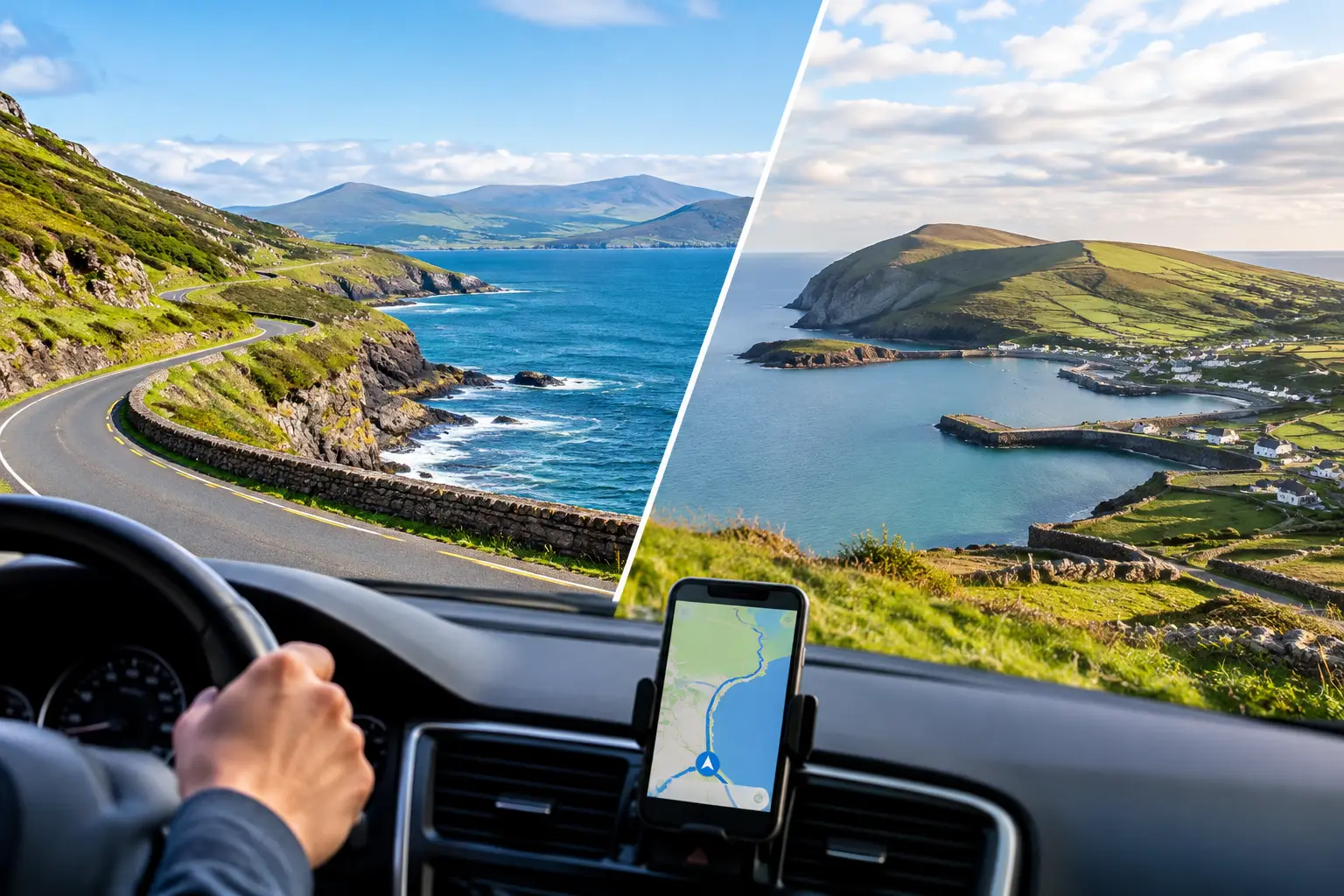
The choice between a Ring of Kerry or Dingle Peninsula self-drive tour is not really about finding the better route. Both deliver big Atlantic views, colourful towns, mountain roads and memorable places to stop. The real question is what kind of day you want from your holiday: a classic, varied circuit with famous sights, or a wilder coastal drive where the landscape often feels closer and less polished.
If you have time for both, do both. If you have one full day, choosing the route that suits your pace, confidence and interests will make the difference between a brilliant drive and a rushed one.
Ring of Kerry or Dingle Peninsula self-drive tour: the quick answer
Choose the Ring of Kerry if you want an iconic all-round Kerry experience. It combines lakes, mountains, historic sites, coastal viewpoints, villages and the handsome town of Kenmare or lively Killarney as a base. It is particularly good for first-time visitors who want plenty of choice along a well-known route.
Choose the Dingle Peninsula if rugged coastlines, quieter roads, Gaelic culture and small-scale discoveries appeal more. The route around Slea Head is compact enough to enjoy at an unhurried pace, but the scenery is dramatic from the moment the peninsula opens towards the Atlantic.
Neither route is a shortcut. Both reward allowing a full day, even though the driving distance alone may look manageable on a map. Narrow sections, scenic stops, traffic in summer and the temptation to pull over for another photograph all add time.
What the Ring of Kerry does best
The Ring of Kerry is the more varied of the two drives. Starting from Killarney, you can pass through or near the national park, the lakes, Moll’s Gap, Kenmare, Sneem, Waterville, Caherdaniel and Glenbeigh before returning towards Killarney. The character changes frequently: wooded valleys become open mountain passes, then sheltered bays and wide coastal horizons.
This is the route to choose when your group cannot agree on one type of scenery. Someone interested in heritage can make time for stone forts or historic houses, while walkers, photographers and beach lovers will find their own reasons to stop. Families can break up the day with short walks, playgrounds or ice cream in a village rather than trying to make every stop a major attraction.
It also works well for travellers staying in Killarney. You can begin without a long transfer, and there are numerous places to pause for food, toilets or a change of plan. That flexibility matters when Irish weather changes quickly.
The trade-off is popularity. In the main holiday season, the Ring of Kerry can feel busy, especially around well-known viewpoints and towns. Many large coaches follow an anti-clockwise direction, so independent drivers often find a clockwise journey more comfortable. Check local conditions on the day, however, and do not force an itinerary simply to avoid other vehicles.
Allow room for the detours
The main Ring of Kerry road is only part of the story. The Skellig Ring, for example, offers a more remote coastal branch and exceptional views towards the islands on a clear day. It adds time, so it is better treated as a deliberate choice than an extra squeezed into an already full schedule.
Likewise, viewpoints such as Ladies View or mountain roads near Moll’s Gap deserve more than a quick car-park stop. If you want a relaxed lunch in Kenmare and a worthwhile detour, start early and accept that you may not see every signed attraction.
What the Dingle Peninsula does best
The Dingle Peninsula feels more concentrated. Its headline route is the drive west from Dingle town around Slea Head, where cliffs, beaches, offshore islands and ancient sites appear in rapid succession. The road is intimate in places, with stone walls, grazing sheep and sea views that seem almost level with the windscreen.
For many visitors, this is Kerry at its most immediately atmospheric. You do not need to travel far between stops, which makes it ideal for travellers who prefer short walks, frequent photographs and time to linger in one place. Dingle town itself adds another reason to choose it: a harbour setting, good places to eat and a strong local character at the beginning or end of the drive.
The peninsula has depth beyond its famous western loop. The road across Conor Pass offers striking mountain scenery, while Inch Beach provides a long sweep of sand and sea. Early Christian sites, beehive huts and Irish-language cultural connections give the drive a sense of history as well as scenery.
The trade-off is road width. Slea Head is best approached patiently and with confidence. Some sections are narrow, parking can be limited at popular stops, and you may need to reverse carefully or wait for an oncoming vehicle. It is entirely manageable for attentive drivers, but it may not be the best choice for someone who is very anxious about narrow rural roads.
Drive Slea Head in the recommended direction
Follow the usual one-way flow around the Slea Head loop, generally travelling west from Dingle town and continuing around the coast before returning from the east. It makes meeting traffic easier on tighter stretches and allows the best coastal views to unfold naturally.
Do not mistake a compact route for a quick one. A half-day drive is possible if you only stop at a few viewpoints, but a full day gives you time for a beach walk, an ancient site, a proper lunch and the freedom to wait out a passing shower.
Which route suits your holiday base?
Your accommodation can make the decision straightforward. If you are based in Killarney, the Ring of Kerry is the simpler full-day outing. The Dingle Peninsula is still possible, but reaching Dingle town first takes time and reduces the hours available for the coast.
If you are staying in Dingle, the peninsula should be your natural choice. You can begin before the day-trippers arrive, enjoy the route without watching the clock and return to town for dinner. From Tralee, either can work, though Dingle is closer. From Kenmare, the Ring of Kerry is usually the more logical fit.
Travellers moving between towns should avoid trying to turn either route into a transfer day with too many obligations. Driving from Killarney to Dingle via the peninsula or from Dingle towards Kenmare via the Ring can be rewarding, but luggage, check-in times and poor weather reduce your freedom. Pick a smaller section rather than attempting every highlight.
Consider your car and driving confidence
A small car hire is often easier on both routes. It fits more comfortably on narrow lanes, is simpler to park and takes some pressure out of meeting traffic. Whatever vehicle you have, keep left, slow down before blind bends and use designated parking areas rather than stopping in the carriageway for a photograph.
The Ring of Kerry generally feels broader and more forgiving, although it includes winding sections and mountain roads. The Dingle Peninsula, particularly Slea Head, feels more exposed and narrower. For a driver new to Ireland, the Ring may be the gentler first scenic drive. For a confident driver happy to take their time, Dingle can be the more immersive one.
Weather also changes the experience. Low cloud can hide mountain views on the Ring of Kerry, while wind and rain can make Dingle’s exposed coast feel dramatic but less comfortable for long stops. If you have flexibility, look at the forecast and choose accordingly. A bright, clear day suits both, but Dingle is especially rewarding when visibility stretches across the Blasket Islands.
Make the route your own, not a checklist
The strongest self-drive days have a loose structure: choose two or three must-see stops, leave space for lunch, then let the road offer the rest. A GPS-guided route can remove the worry of missing a turn while still allowing you to skip a stop, stay longer at a beach or follow a local recommendation.
MyDriveTour is designed for that kind of independent day out, with suggested stops, GPS-guided routes and short audio introductions at selected sights. Downloading the app is free, while its self-guided tours are purchased separately, so you can choose the route that fits your itinerary rather than joining a fixed group timetable.
Whether you choose the Ring of Kerry’s changing landscapes or Dingle’s Atlantic edge, give the day permission to run a little slower. The most lasting Kerry memory may be the stop you had not planned at all.
