
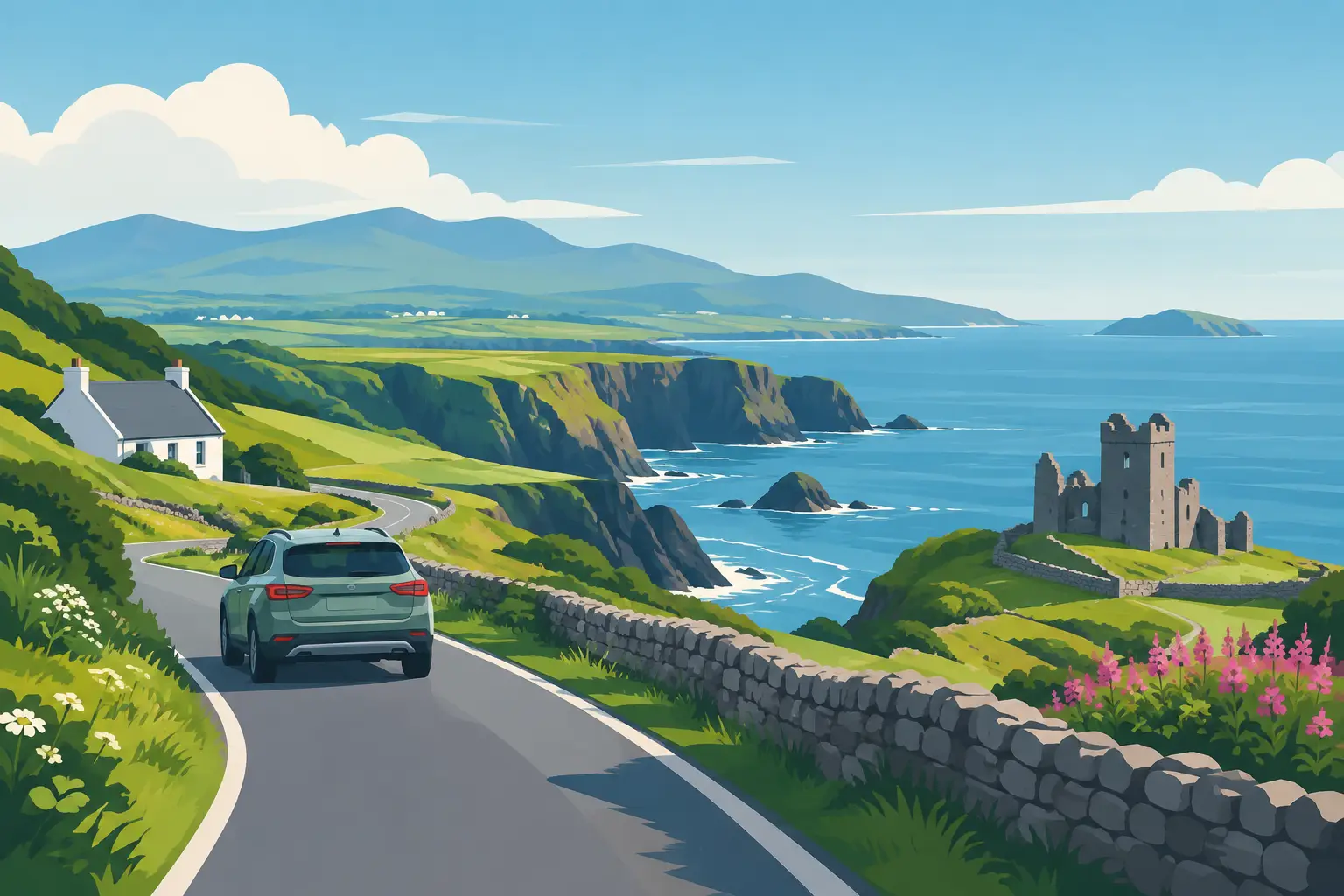
The best moments on an Ireland hidden gems road trip rarely happen at the largest car park. They happen when you turn off the main route for a harbour where fishing boats still set the pace, a mountain pass with no coach queues, or a ruined church whose story suddenly makes the landscape feel different. Ireland rewards the curious driver, but its quieter places are easier to enjoy when the route is realistic, the roads are understood and there is time to stop.
What makes a hidden-gems road trip worthwhile?
A hidden gem does not have to be undiscovered. In Ireland, many of the most rewarding places are well known to local people and are quietly loved by walkers, swimmers, history enthusiasts and families. They simply sit beyond the headline attractions, with less signage, fewer facilities and more need for a little planning.
The trade-off is part of the appeal. A narrow coastal road may take longer than the kilometre count suggests. A small café may close early outside summer. A beach can look completely different at high tide. Give these stops room in your day and they become highlights rather than rushed diversions.
The seven places below work particularly well as additions to a wider driving holiday. They are not intended as one rigid route across the island. Choose the stops that suit your direction of travel, interests and available time.
7 stops for an Ireland hidden gems road trip
Gleniff Horseshoe Drive, County Sligo
Beneath the limestone slopes of Benbulben country, the Gleniff Horseshoe is a short loop with enormous scenery. The road winds through a dramatic valley shaped by ice, with views of sheer cliffs, grazing sheep and the remains of old mining activity. It is an ideal detour for travellers heading between Sligo town and Donegal.
This is not a road to hurry. Some sections are narrow, so use passing places considerately and let local traffic set the pace. On a clear morning, the scale of the valley is extraordinary; in mist, it feels beautifully wild and mysterious. Combine it with a walk near Glencar or a stop in a local village rather than trying to cover every Sligo sight in one day.
The Bridges of Ross, County Clare
At the far end of the Loop Head Peninsula, the Bridges of Ross show off the Atlantic at its most energetic. These natural sea arches sit at the edge of low cliffs, where waves drive into the rock and seabirds wheel above the water. It is a bracing contrast to the busier Cliffs of Moher further north.
The path from the parking area is short but exposed, so sturdy footwear and a windproof layer are sensible even in summer. Keep well back from cliff edges, especially in rough weather. The Loop Head drive itself is part of the reward, passing small settlements, open farmland and views across the Shannon Estuary.
Allihies and Ballydonegan Bay, Beara Peninsula
The Beara Peninsula is a strong choice for travellers who want west-coast drama with a gentler pace than some of Ireland’s better-known touring routes. Allihies, near its western tip, is a colourful village with a copper-mining past, set between rugged hills and the sea. Nearby Ballydonegan Bay brings clear water, pale sand and dark rocks into one memorable coastal scene.
The roads on Beara are scenic but can be tight and twisting. That is exactly why this part of Cork and Kerry deserves an unhurried day or two. Park up, walk a stretch of beach or village lane, and resist the temptation to treat the peninsula as a quick tick-box detour from the Ring of Kerry.
Gougane Barra, County Cork
Gougane Barra feels like a secret held inside a mountain bowl. Its tiny island oratory, sitting beside a lake beneath forested slopes, is one of the most atmospheric places in the south-west. It has deep associations with St Finbarr and is often described as a place of pilgrimage, but no specialist knowledge is required to appreciate its stillness.
There are forest trails nearby, from easy strolls to longer walks, making this a useful stop for families who need a break from the car. Weather changes quickly among the hills, and cloud or rain can add to the mood rather than spoil it. Allow time to walk beyond the famous view; the setting is the attraction.
The Copper Coast, County Waterford
Between Tramore and Dungarvan, the Copper Coast offers coves, cliffs and old mining landscapes without the crowds often found on Ireland’s western seaboard. Its name comes from the nineteenth-century copper industry, while its rock formations reveal a far older geological story. You do not need to be a geologist to enjoy it – the changing colours of the cliffs and the sweep of the bays do the work.
Bunmahon is a practical base for a beach walk and a look at the coast’s industrial heritage. This stretch is especially satisfying for travellers touring the Sunny South East, where a short detour can turn a straightforward drive into a day of small discoveries. Check tide and weather conditions before setting out on coastal paths.
Mamore Gap, County Donegal
Mamore Gap is a steep mountain pass on the Inishowen Peninsula, with a view that makes drivers naturally slow down. From the summit, the land falls away towards the sea, with Lough Swilly on one side and Atlantic horizons on the other. It is a magnificent route for confident drivers who are comfortable on narrow roads.
This is a place where conditions matter. Low cloud, heavy rain and high winds can reduce visibility, while large vehicles are not suited to the route. If the weather is poor, choose the longer alternative road and save Mamore Gap for another day. On a fine day, pair it with nearby villages, beaches or the coastline around Malin Head.
Torr Head Scenic Route, County Antrim
The Causeway Coast has famous landmarks, but the Torr Head Scenic Route gives independent travellers a more intimate side of north Antrim. Between Cushendun and Ballycastle, it climbs and falls through farmland and headlands, with Scotland often visible across the water. Stone cottages, grazing animals and sudden sea views make the journey feel distinctly local.
It is not the fastest way between two points, nor is it suitable for everyone. Parts are steep, narrow and demanding, particularly for nervous drivers or larger vehicles. Those willing to take it slowly are rewarded with a memorable alternative to the main coastal road. Stop only where it is safe and avoid blocking passing traffic.
Plan for the road, not just the photograph
Ireland’s quieter routes work best when you plan fewer stops than you think you can manage. A day that looks simple on a map can include single-track lanes, a ferry timetable, a sudden rain shower and an irresistible village bakery. Build in space for all of it.
Start with one major destination and two or three smaller stops. If your group enjoys walking, make that the priority rather than squeezing in another viewpoint. If you are travelling with children, choose a beach, woodland trail or castle ruin where they can move about freely. Travellers who prefer history may get more from an ancient monastic site and a local museum than from a long list of scenic lay-bys.
Reliable navigation matters, but so does context. A turn-off is more meaningful when you know why an abandoned mine stands on the hillside or how a saint, shipwreck or famine-era road shaped the place around you. MyDriveTour brings professionally curated routes, practical navigation and location-based audio commentary together, so you can follow your own pace while hearing the stories at the point where they matter.
Give the quiet places the time they deserve
The finest detour may be the one you only half planned: a conversation in a village shop, a five-minute view that becomes half an hour, or a road you decide not to rush. Keep your itinerary flexible, drive with care and leave enough daylight for the last scenic stretch. That is when Ireland starts to feel less like a list of attractions and more like a place you have genuinely travelled through.
