
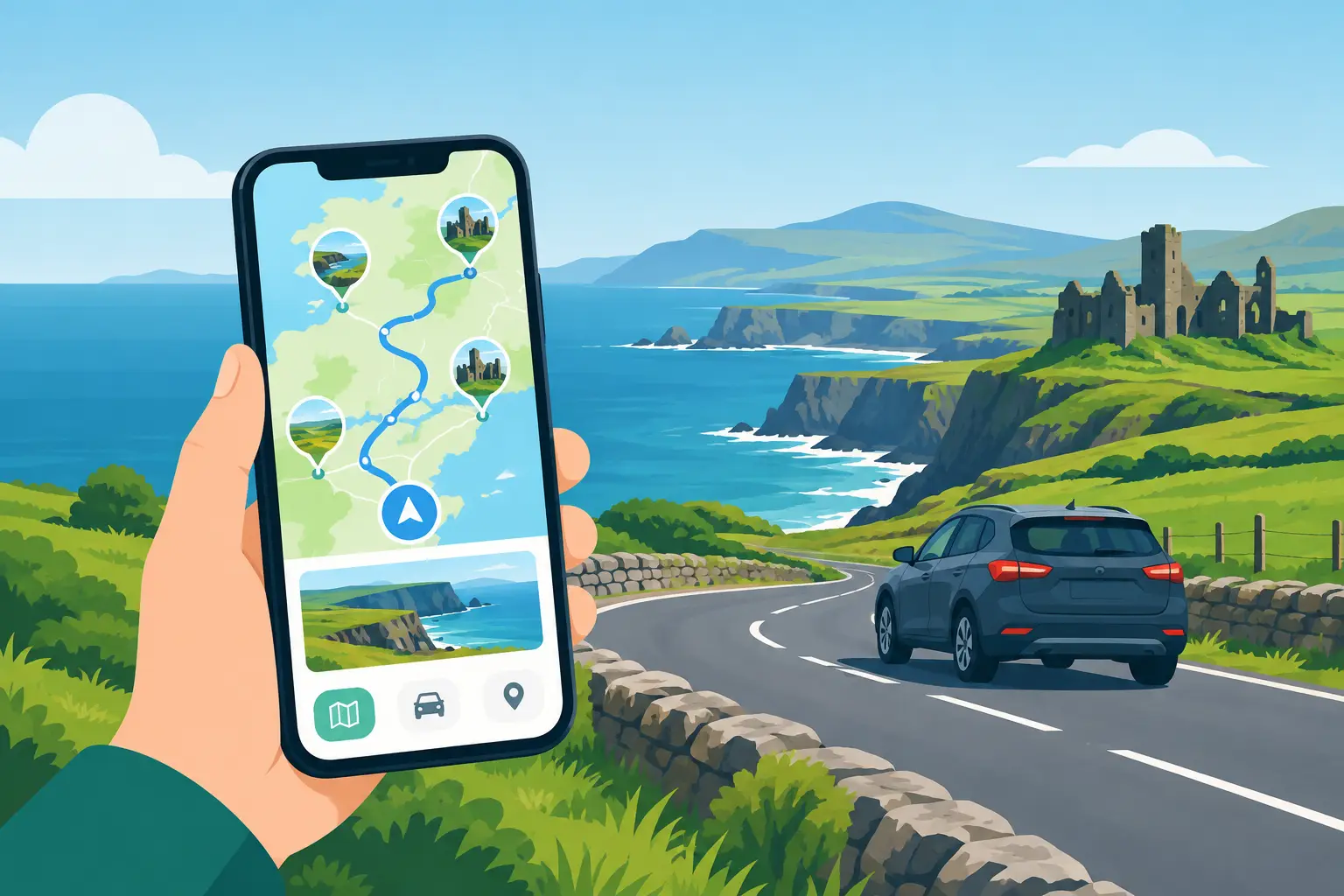
A coastal road can look straightforward on a map, yet the best part of an Irish drive is rarely the road alone. It is knowing why a ruined abbey matters, where to pause for the view locals love, and which turn leads to a small harbour rather than an unnecessary detour. The right Ireland travel app gives independent travellers that confidence, turning a self-drive holiday into an experience with shape, stories and room to spare.
For visitors arriving from Britain, Ireland can feel wonderfully familiar while still presenting plenty of choices. Distances may look short, but narrow lanes, scenic diversions, weather and the temptation to stop often make days take longer than expected. A good touring app does not rush you through the country. It helps you make better decisions as you go.
What an Ireland travel app should do
A map app is essential, but it is not a tour guide. It can show the quickest route from Killarney to Kenmare or Belfast to the Giant’s Causeway, yet it cannot explain why one road is worth taking over another, what you are passing, or where the worthwhile stops sit between the headline attractions.
A purpose-built Ireland travel app should bring those elements together. It should provide a professionally planned route, clear directions and useful context at the moment it matters. For self-drive travellers, that means less time scrolling through reviews in a car park and more time looking at the landscape.
The most useful apps combine four things: a sensible itinerary, navigation that works with your preferred mapping app, location-based audio and practical information for places you may want to visit. Together, these features create a guided experience without the fixed timetable of a coach trip or the cost of a private driver.
A route built around the real journey
Ireland rewards travellers who look beyond the fastest route. The Wild Atlantic Way, Ring of Kerry, North Antrim Coastal Drive and the Sunny Southeast all have famous sights, but their character is found in the stretches between them. A well-designed tour considers the flow of the day: where the views open up, which stops naturally follow one another and when a longer pause is likely to be welcome.
That structure matters, especially if you are touring with family or only have a few days in a region. You can begin at a point that suits your accommodation, skip stops that do not appeal and spend longer at the places that do. The route should serve your holiday, not dictate it.
Audio that arrives at the right place
Reading a guidebook while trying to enjoy a drive is neither safe nor particularly relaxing. Automatic audio commentary offers a better way to learn as you travel. When commentary is triggered by your location, you hear the story of a castle, village, mountain pass or coastline as it comes into view.
This makes a marked difference to the atmosphere in the car. Passengers are not required to act as researchers, and the driver is not being asked to follow a stream of instructions. Everyone can share the experience, whether the subject is local folklore, Irish history, film locations or the working life of a fishing community.
The quality of that commentary matters. Generic facts can be found anywhere. Stories drawn from the knowledge of qualified Irish tourist guides and experienced chauffeurs give a place its proper context and help visitors notice what might otherwise pass by unnoticed.
Planning a self-drive tour with an Ireland travel app
The app is most useful when you make a few choices before setting off. Start by looking at the route as a full day rather than simply counting kilometres. A 100-kilometre journey through open motorway country is very different from 100 kilometres along a coast road with viewpoints, villages and single-track sections.
Choose the stops that matter most to your group first. Perhaps you want the Giant’s Causeway, Dunluce Castle and a coastal lunch in Northern Ireland, or a mix of lakes, waterfalls and small towns around Kerry. Then leave room for the unexpected: a hand-painted sign for a beach, a craft shop, a quiet café or a viewpoint that deserves twenty minutes longer than planned.
Before departure, it is worth checking four practical details:
- Confirm your starting point and the direction of travel for the day.
- Send the route to the mapping app you normally use and make sure navigation volume is audible.
- Download any tour material you may need while connected to reliable Wi-Fi.
- Check opening times, booking requirements and parking arrangements for major attractions.
These small preparations prevent frustration later, particularly in rural areas where mobile coverage can vary. They also mean you can concentrate on the road and the scenery rather than troubleshooting settings at the first junction.
Let navigation handle the road, not the whole holiday
There is a useful balance to strike between following a route and keeping your freedom. Navigation is there to remove uncertainty, particularly around unfamiliar roads, parking areas and town centres. It should not make your day feel like a delivery schedule.
If rain closes in on a cliff walk, a child needs a break, or you find a village you want to explore, adjust your plans. The benefit of a self-guided tour is that you remain in charge. Simply continue with the next stop when it suits you, or select another point of interest nearby.
That flexibility is especially valuable on Irish roads. Conditions can change quickly, and scenic routes often take longer than first expected. Travellers who allow extra time tend to enjoy the day far more than those determined to tick off every marked attraction.
Famous landmarks are only part of the story
Most visitors rightly want to see Ireland’s celebrated places. The Giant’s Causeway deserves its reputation, as do the sweeping views along the Ring of Kerry and the dramatic Atlantic coast. But a memorable trip usually includes quieter moments as well: a short walk to an overlooked viewpoint, a churchyard with a compelling local connection, or a village where lunch becomes the highlight of the afternoon.
This is where a guided app can earn its place on your phone. It helps you find the less-commercial discoveries that do not always rise to the top of a general search result. More importantly, it explains how they fit into the wider story of the area.
A hidden gem should not be included simply because it is obscure. It should add something real to the journey: a better view, a local tradition, an unusual piece of history or a welcome contrast to a busy visitor attraction. The best routes balance the well-known and the personal.
Who benefits most from a guided driving app?
Independent travellers are the natural fit. If you enjoy choosing your own pace but do not want to spend every evening researching the next day, a guided app offers a practical middle ground. You retain the freedom of a hire car or your own vehicle while gaining much of the insight associated with a guided tour.
It also works well for couples with different interests. One person may be drawn to historic houses while the other wants coastal walks and food stops. A flexible itinerary makes it easier to include both without turning the day into a negotiation. Families can use the same freedom to shorten a route, add a beach stop or avoid asking younger passengers to endure one more museum.
For first-time visitors, the reassurance is often as valuable as the information. Ireland’s road network is manageable, but an unfamiliar landscape can make planning feel harder than it needs to be. Clear routing and timely commentary replace uncertainty with a sense of direction.
Choosing the right tour for your route
Choose a tour that matches where you are actually staying, rather than buying a broad itinerary that looks ambitious on paper. A day around the Wild Atlantic Way calls for a different rhythm from a day in the Sunny Southeast, while Northern Ireland’s Causeway Coast has its own sequence of coastal scenery, heritage and villages.
Look for tours that make the practical side clear. You should be able to understand how to access the route, how commentary is triggered, whether you can choose your own stops and where to find deeper details about attractions. Those details are what make an app useful once you are on the road.
MyDriveTour is designed around that experience, translating decades of Irish tourism knowledge into self-guided driving and walking tours that travellers can enjoy at their own pace. It pairs curated itineraries with mapping directions, automatic commentary and useful attraction information, so the guide is there when you need it and quiet when you simply want to take in the view.
Make room for the moments you did not plan
A travel app should make an Irish road trip feel easier, not more controlled. Use it to understand the route, hear the stories and find the places that add depth to your holiday. Then give yourself permission to stop when a view catches your eye, linger over lunch or take the slower road home. Those unplanned pauses are often where Ireland stays with you longest.
